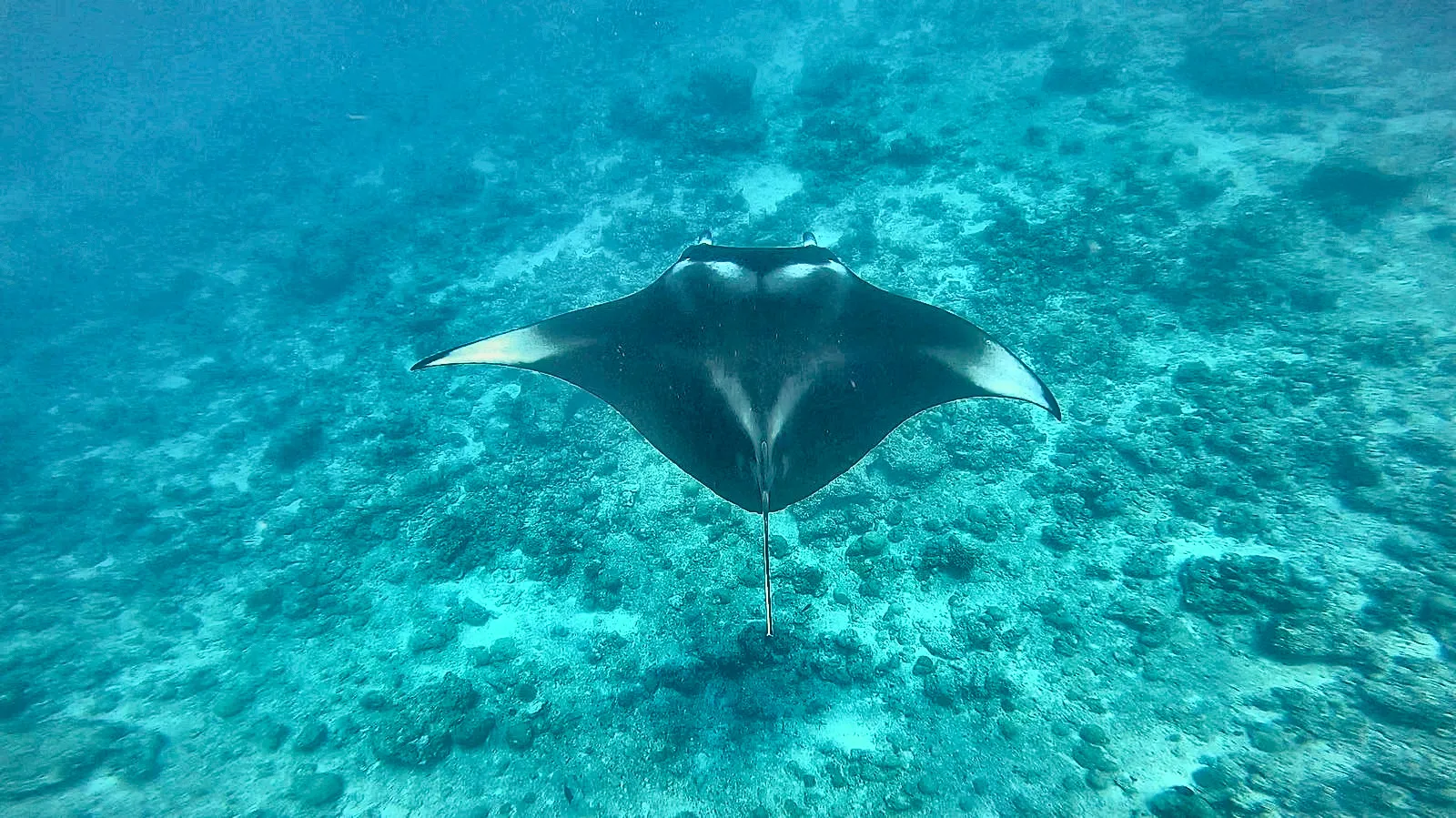
Travel report
Manta rays in the Maldives: my first encounter, snorkeling off Rasdhoo
Translated from the German original.
Ten meters below me, the manta tilts its wingtips by a few degrees, and all at once it is coming straight toward me. I’ve been holding my breath since I dove down. Now I hold it a little tighter.
A quick word first, in case you’re planning right now: In Rasdhoo Atoll, you don’t see mantas to order. We had booked a boat trip with several stops, and the manta was pure luck. Hanifaru Bay in Baa Atoll is more reliable: there they gather to feed from May to November. On the house reef of Rasdhoo, on the other hand, there is something to see every day, without a boat and without a booking.
But first things first.
We had booked a boat trip with several stops through our hotel on Rasdhoo, a local island in the middle of the Maldives: Summer Vibes Beach Front, which we were truly happy with all around. Even when booking, they had told us very fairly where we stood: it isn’t manta season, and it’s quite possible we won’t see a single one. Breakfast, fins, off onto the boat. And I notice how this tingle just can’t be switched off anyway, when somewhere out there one might be waiting.
Half an hour by boat later, the first stop. A few boats are already there, but in the water there are maybe ten of us (in Egypt, fifty, eighty people crowd on top of each other at a spot like this). Snorkel in my mouth, head under water. And there, far below and already gone again: a single wingbeat, barely recognizable as a manta. I kick after it as fast as the fins will carry me. But there’s nothing there anymore. Just blue that grows darker and darker further down. Back onto the boat.
The guide climbs forward onto the bow and peers into the water while we slowly putter along the reef edge. Once the boat stops. Nothing. Once more. Nothing. I’m already starting to come to terms with “maybe not today.” And that is exactly when his call comes: into the water, quick! We let ourselves slide over the side as carefully as we can, no rush, no splashing, no commotion in the water. The engine falls silent. I know exactly what I’m looking for: a big, calm movement down there; the guide did talk about mantas, after all. And I see it right away. That is a manta.
My first. For a snorkeler it is deep, a good ten meters below the surface. The water is so clear and warm that the sunlight reaches all the way down to it in bright bands. The longer I look down at it, the less I want to believe how big it is. A good four meters from one wingtip to the other. A flat dark sail that simply carries itself. Not a single hurried stroke. It has all the time in the world. I have exactly one lungful.
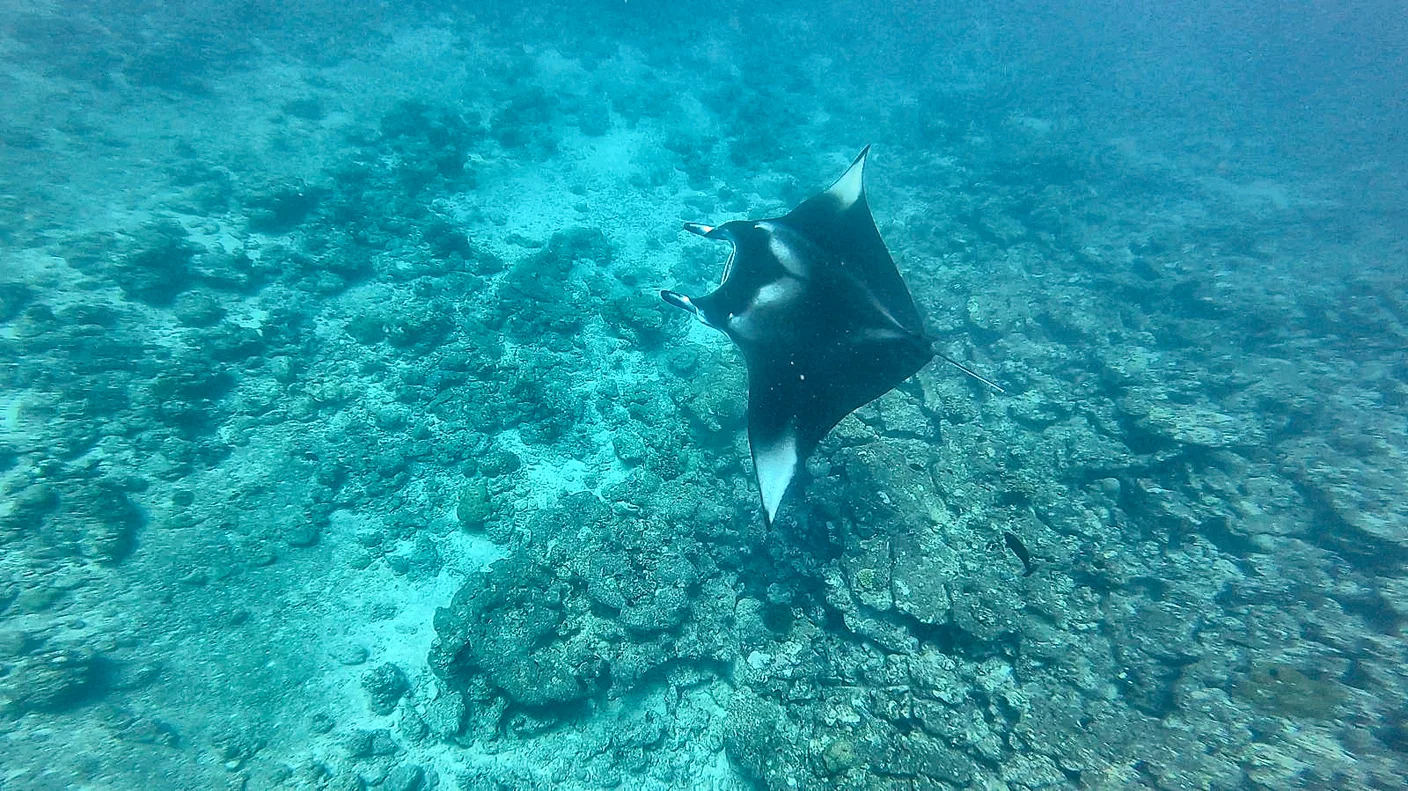
I take a deep breath and dive down. The water closes in tighter around me, the pressure makes itself felt in my ears, and with every meter it grows bigger. From above it is just a dark back. Then it turns, in my direction, and as it does, its pale underside tips into the light, white contours where the dark upper side was a moment ago. Oh man, I think, now it’s coming straight at me. And then there is only it. So calm, so close. For a few seconds there is nothing but this animal and me. No boat, no up. Then my air is gone, and I have to go up.
So back down. And again. A few seconds beside it, back to the surface, breathe, dive down. At some point it sinks deeper than I’m used to. On the way down I have to equalize my ears twice. And when I finally get there, there’s hardly any air left for the moment I came for. That’s the only thing that bugs me: that my air is never enough. I would so love to stay down longer, simply drift beside it, instead of having to go back up after a few seconds. And still, even this little bit of time makes me happy every single time, even if it’s just for three heartbeats.
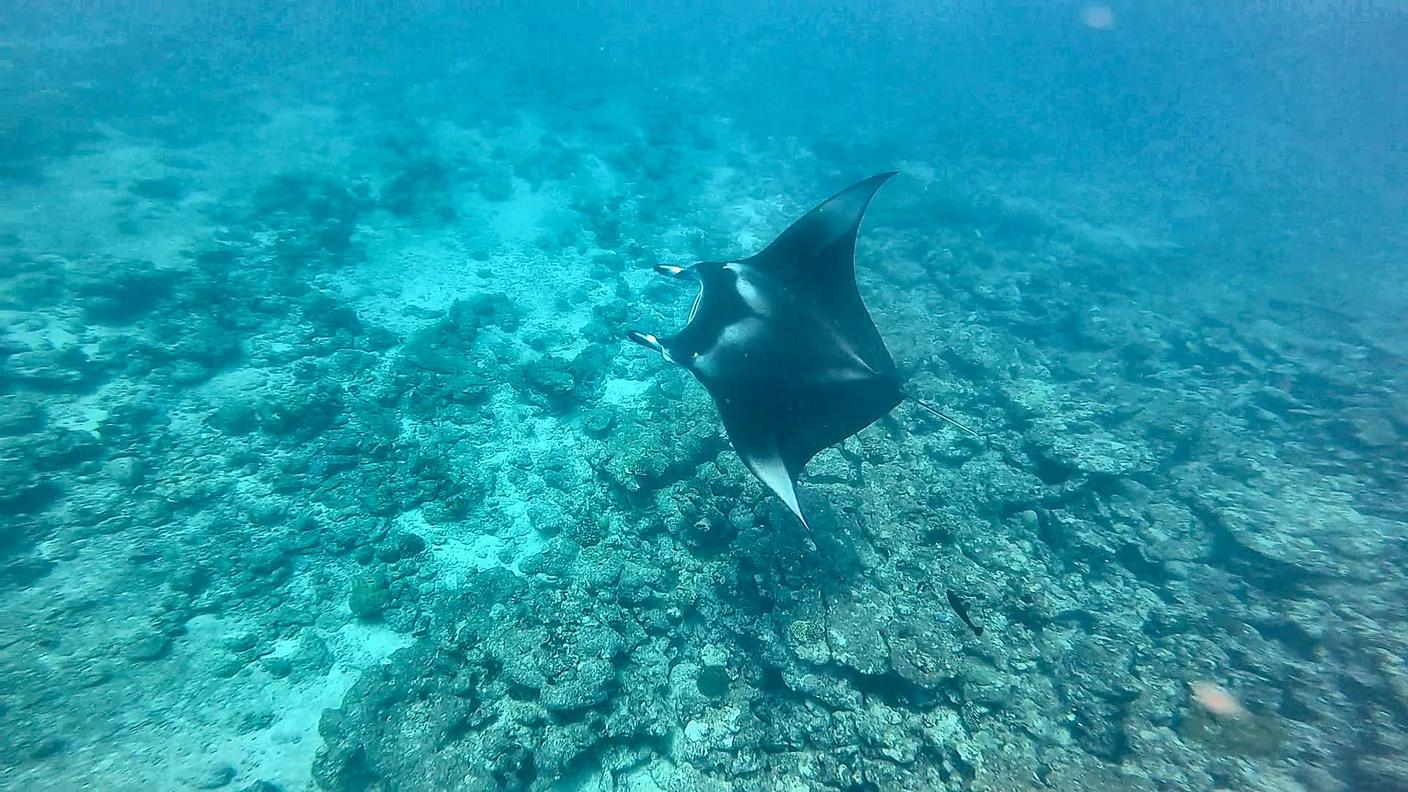
After a good twenty minutes it swims its last rounds and then glides away without hurry, out to where the blue has no bottom anymore. We climb back onto the boat, out of breath, and lean over the small camera displays to see whether that really just happened. On a day when nobody had promised us anything.
You shouldn’t count on anything, they say. And that’s precisely when the biggest thing comes.
Moments exactly like these are the reason why Riffnah exists.
How crowded is a manta tour? Ten people in the water
The sentence above about Egypt was no exaggeration. What makes or breaks a manta stop is not only the animal, but how many people swim toward it at the same time. With us it was around ten, spread out along a reef edge. Nobody pushed, nobody dove after the animal, and the guide let us into the water one at a time and without splashing.
What the opposite looks like, I experienced a year later off Dhigurah, another island in the Maldives, on a whale shark tour: five meters of animal, fifty snorkelers. The animal was magnificent; the rest was a wall of people. Since then, before every booking I ask about the group size; that is the one question that reveals more about the day than any description.
Rasdhoo snorkeling: more than mantas
We were out on the boat that day because in April there’s hardly any way around it. On the island’s own house reef, less than a hundred meters from the beach, on the other hand, there is something to see every day: that’s where, on the day we arrived, my first shark was in front of me, and that’s where blacktip reef sharks come right into the shallow water. Ten minutes away by boat lies Turtle Reef with its turtles; how that day went is in Snorkeling with turtles.
And one thing I only learned later: in August, a reef manta passed by the same house reef every morning, with no boat and no tour at all. In April we had to go out for it and were lucky. The measurements from both times are side by side on the island page for Rasdhoo.
Rasdhoo manta season, depth and crowds: good to know
- Where: Rasdhoo, a local island in Rasdhoo Atoll (Maldives). On our trip, the manta spots were around half an hour away by boat.
- Conditions (April 2025): 29 °C water temperature, around 25 meters visibility. The manta was a good ten meters below the surface. The visibility is my own estimate in the water.
- Best time (manta season): Mantas stay in the atolls of the Maldives all year round and switch sides with the monsoon. From December to March they keep to the west side of the atolls, from April to November to the east side; the wind drives their food there each time. A study by Harris and Stevens (2021) over several years showed this. So there is no fixed manta time, but there is the spot that fits the season. Still, nothing is guaranteed: we were told honestly that it was not the best time just then, and we were lucky anyway. Best to ask the hotel or dive center about the current situation beforehand.
- How it went: The guide searches several spots from the bow; only once a manta has been sighted do you get into the water, calmly and without rushing.
- Depth: For snorkelers, mantas are often quite deep (for us around ten meters). Diving down repeatedly while holding your breath is part of it.
- Crowds: At our spot there were around ten snorkelers in the water, noticeably more relaxed than at heavily visited spots in the Red Sea. Ask about the group size before booking; see whale shark tour from Dhigurah.
- Camera: I still filmed this manta with the GoPro. Why I later switched to the Insta360 is in my camera comparison.
- Holding your breath: If you want to see the manta up close, you have to be able to dive down. My gear for this is deliberately simple; more doesn’t help much here.
- Without a boat: In August, a reef manta passes the house reef in the morning, reachable directly from the beach. In April it only worked with a tour.
- If sharks are on your mind: On the same house reef I had my first encounter: “My first shark”.
- The whole trip: Rasdhoo and Fulidhoo in one week: travel report; all the islands and seasons in the Maldives destination guide.