Travel report
Napoleon wrasse in Egypt and the Maldives: three encounters on the reef
- Egypt and Maldives
- endangered (IUCN)
- diving and snorkeling
- October 2025 and August 2026
In short The Napoleon wrasse is one of the largest fish on the reef and endangered – I saw it three times on two trips.
Translated from the German original.
While snorkeling I estimated visibility, water temperature and depth, just as I experienced them on the days I was there. On dives the dive computer measured depth and duration, and values with a named source show what is usual there, not how it was for me.
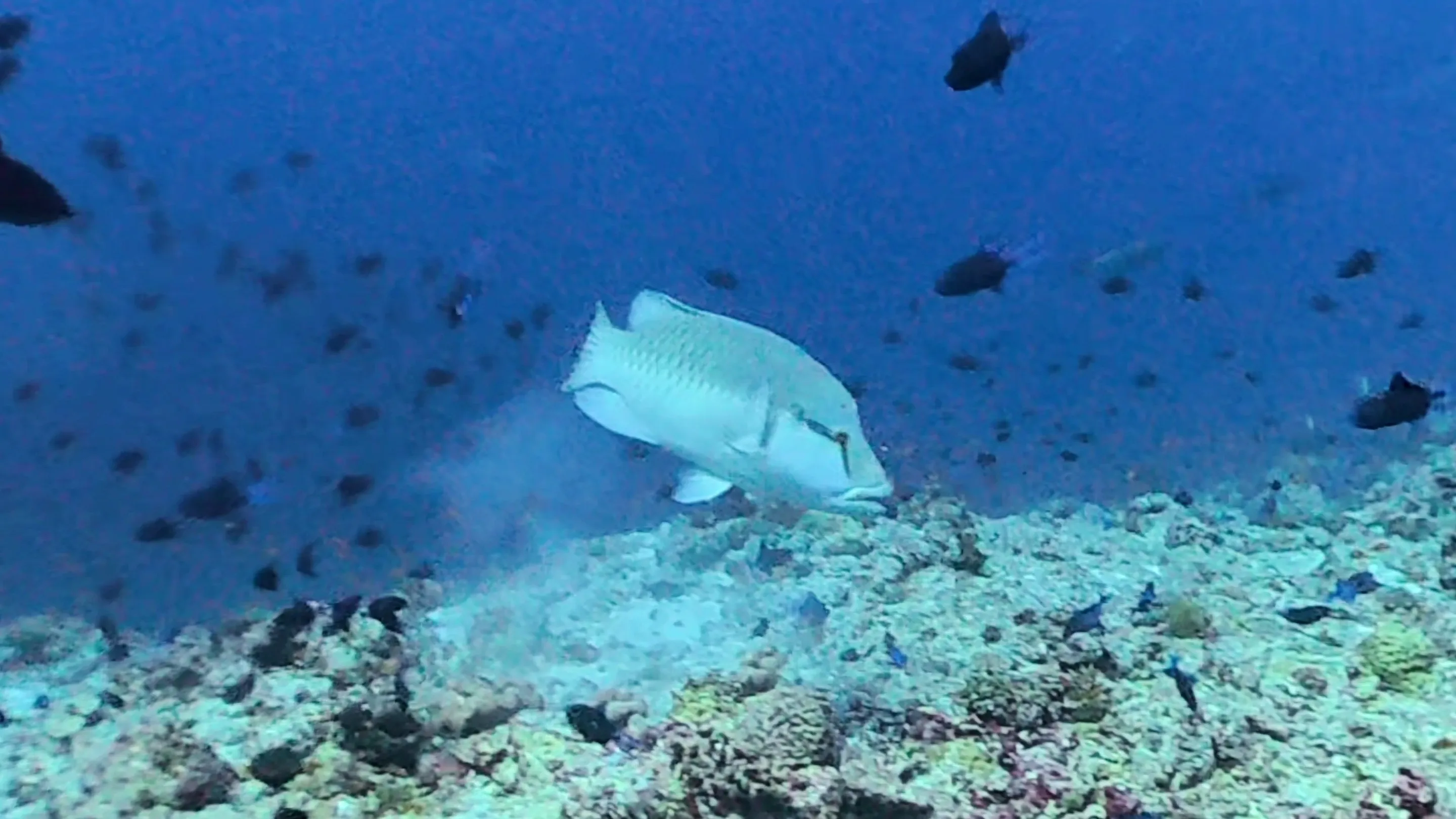
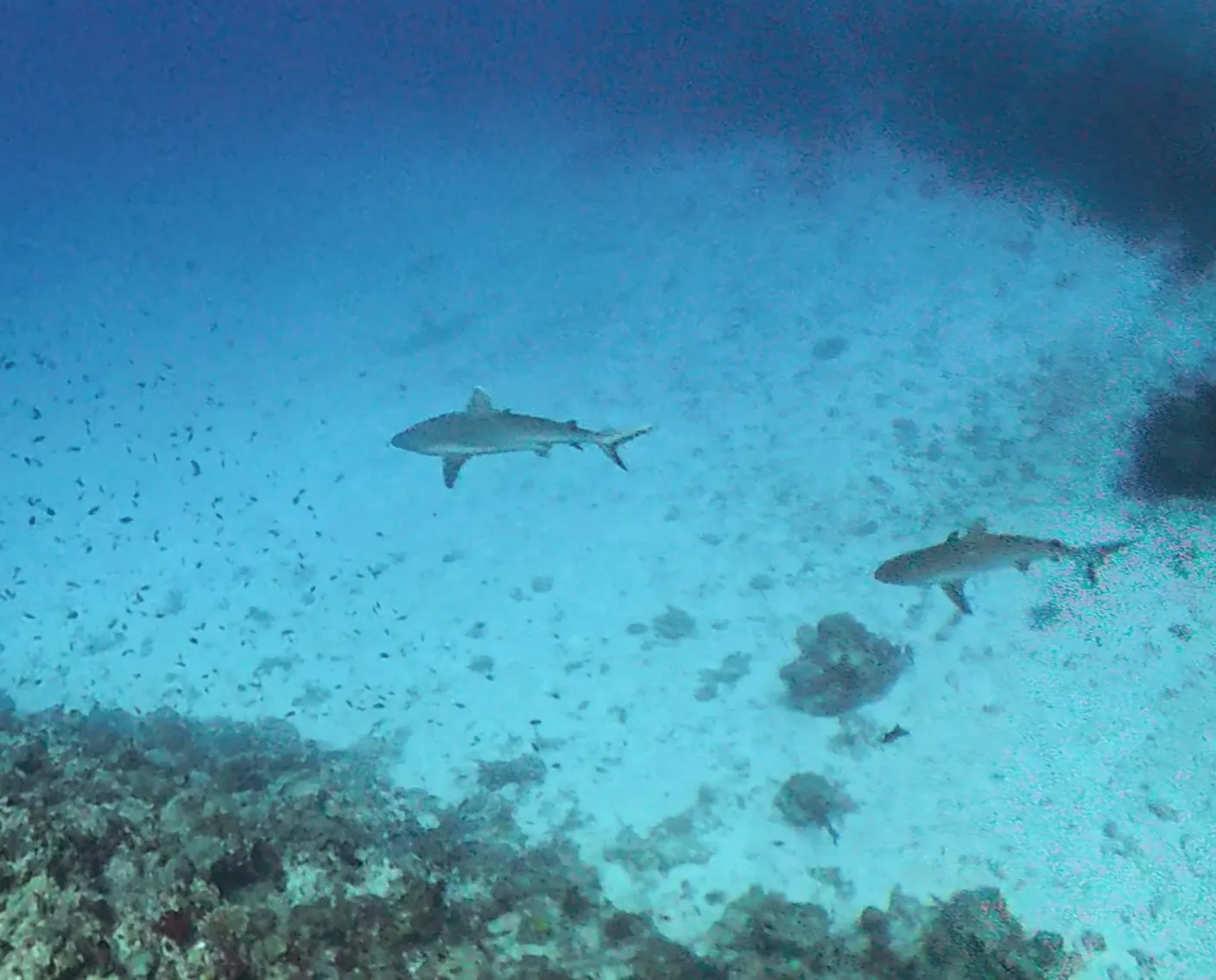
After the dive at Madivaru Corner in the Maldives, I wrote in my diary: Saw lots of sharks, unfortunately again none properly on the video. There were about ten, and all of them were circling far away. Another fish, on the other hand, is fully visible on the video, from head to tail fin. It is a Napoleon wrasse.
The Napoleon fish, in full the Napoleon wrasse, is one of the largest fish on the reef, and it is endangered. I have seen it three times on two trips: while diving in Egypt, while diving at Madivaru Corner and on the house reef of the island of Rasdhoo, both in the Maldives. Anyone who meets one lets it move on in peace and doesn’t feed it.
At a glance
| Name | Napoleon fish or Napoleon wrasse |
| Size | up to 2.29 m and 191 kg, mostly around 60 cm (fish database) |
| Age | over 30 years, 32 on record (fish database) |
| Diet | mussels and snails, sea urchins, crabs, fish; also toxic animals such as boxfish and crown-of-thorns starfish |
| Protection | IUCN Red List: endangered (last assessed in July 2024); Appendix II of the Washington Convention on endangered species; Maldives: export banned since 1995 |
| Madivaru Corner, Maldives | dive on August 19, 2026, down to 17 m, around 20 m visibility, strong current |
| Rasdhoo house reef, Maldives | while snorkeling, in the morning |
| Ras Mohammed, Egypt | dive on October 27, 2025, down to 20 m, around 30 m visibility, no current |
Contents
Madivaru Corner: the Napoleon on my video
On August 19, 2026, I dove at Madivaru Corner off Rasdhoo, in a strong current. That the sharks are hard to make out on the video wasn’t really down to the camera. They kept their distance, and their color blurs into the reef and the water behind it.
The Napoleon was closer. On the video it hovers just above the rubble on the slope, pale and almost white against the blue. It keeps its head close to the bottom, and behind it a cloud of sand rises. Small dark fish dart around it. Then it swims on a little way, again close to the bottom, and again sand rises.
What it was doing there on the bottom, you can’t see on the video. Napoleons mainly eat mussels and snails, sea urchins and crabs. They are also among the few fish that eat toxic animals, such as boxfish or the crown-of-thorns, a starfish that eats coral.
I saw another Napoleon on the house reef of Rasdhoo, in the morning while snorkeling. The reef lies off Bikini Beach. You first swim over shallow corals; beyond them the water quickly gets deep.
Can you see Napoleon wrasses in Egypt too?
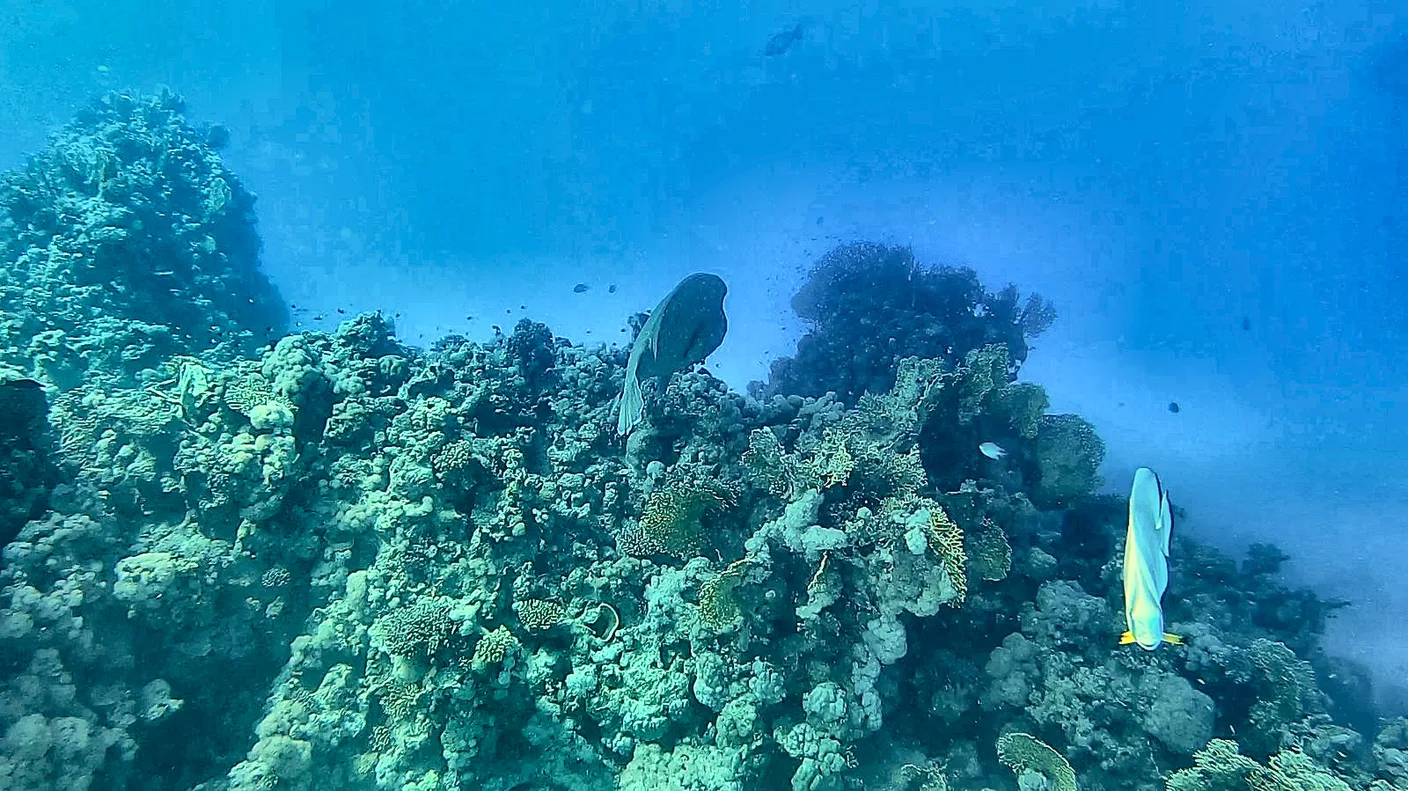
Yes. In Ras Mohammed National Park near Sharm El Sheikh, we came across one in October 2025, right on the first dive of the trip.
A member of our family who has been diving for a long time had wished for exactly this fish. On the trip, the fish was his topic until everyone who was along was rooting for it too. When the Napoleon finally came, we shared his joy underwater.
The two encounters were completely different. The Napoleon at Ras Mohammed came out of the blue and moved slowly along the reef wall. The one at Madivaru Corner stayed close to the bottom, between rubble and clouds of sand, and only ever swam on a little way.
How the whole day on the boat went, I tell in the report from Ras Mohammed. It also describes how diving without certification works in Egypt.
How big does a Napoleon wrasse get?
On a still from Madivaru Corner you see it fully from the side. Above the eyes the forehead bulges forward, the lips are thick, and there is a fine pattern on the pale body. Behind it, sand hangs in the water. How long it was, I can’t say in centimeters.
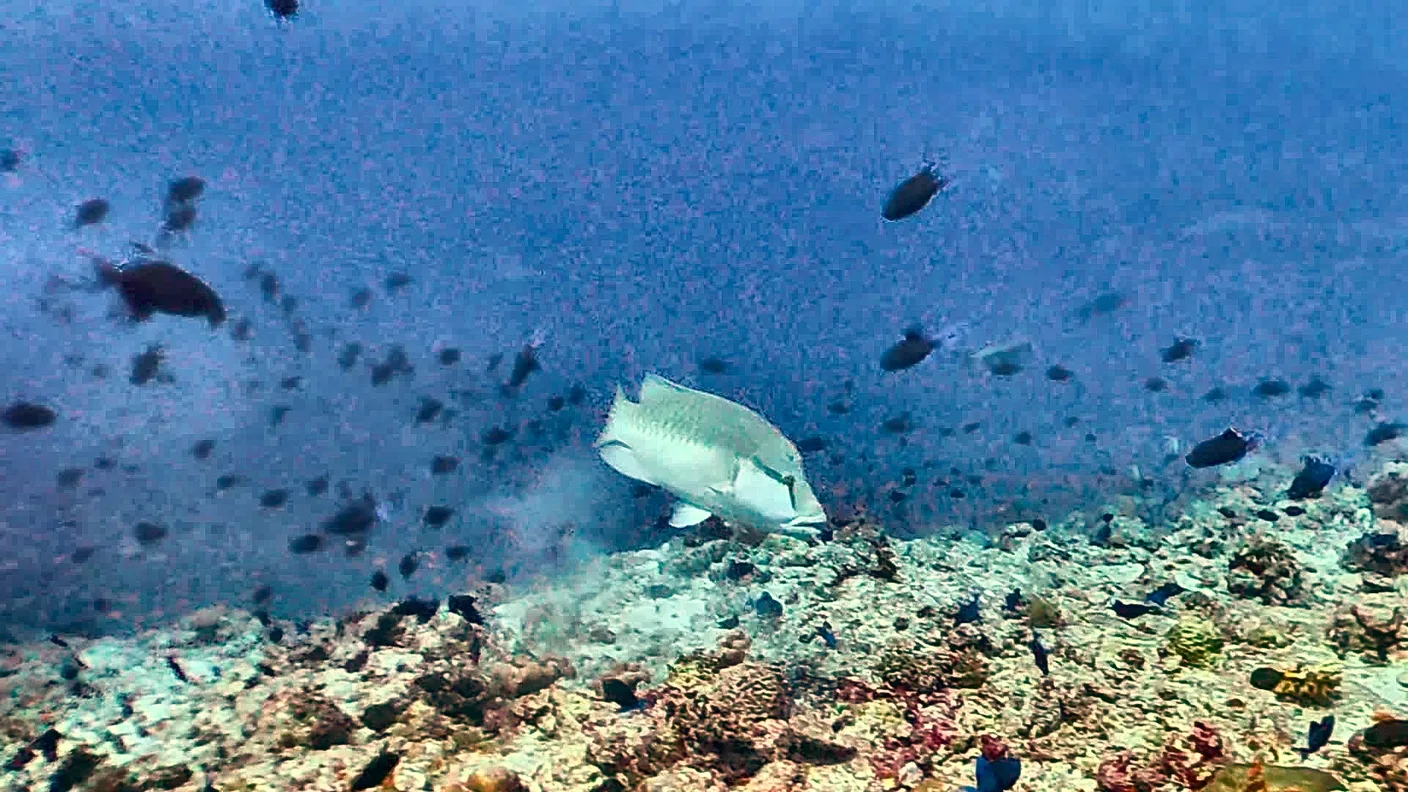
Only a few grow as big as the maximum values in the box. A Napoleon only gets its hump when it reaches sexual maturity, after five to eight years. Then the lips also get thicker, and the bold diamond pattern of the young fades. So the one at Madivaru Corner was not a juvenile. Some females later become males, at around nine years old.
Is the Napoleon wrasse endangered?
According to the IUCN, the Napoleon wrasse has been endangered since 2004. It is mainly caught alive, for restaurants in Asia. It is especially sought after in Hong Kong. It may only be traded across borders with a permit, because it is listed in Appendix II of the Washington Convention on endangered species.
The Maldives banned its export in 1995, as the first country in the world. Almost three decades later, researchers in Laamu Atoll found roughly as many Napoleons as are known from reefs without fishing. Particularly many lived in the channels that open the atoll to the open sea.
Why shouldn’t you feed a Napoleon wrasse?
I advise against trips where animals are lured with food. On the reef, a Napoleon finds its own food. Being fed is not a natural situation for it.
In the Red Sea, divers used to feed it boiled eggs. According to Scuba Travel, the populations declined significantly during that time, and the eggs are considered a cause of health problems. The feeding has since stopped.
Hands off and keep your distance, with the Napoleon as with the reef around it. A coral takes decades to grow and breaks instantly under a careless fin. If you get too close, you will also feel the sting of fire corals or the venomous spines of a lionfish.
My conclusion
If you meet a Napoleon, hover calmly where you are and watch what it does. Keep the camera running as long as it stays on the bottom. And don’t feed it.
At Madivaru Corner I dove below while my wife and our son snorkeled above. I will tell about that in an article of its own.
Frequently asked questions
Is the Napoleon wrasse dangerous?
No. As a danger to humans, the fish database only mentions reports of fish poisoning after eating it. I myself felt safe the whole time in the water in Egypt. Still, you shouldn’t touch or feed it.
Are there Napoleon wrasses in the Maldives?
Yes. I saw one while diving at Madivaru Corner off Rasdhoo and one on the house reef of Rasdhoo.
How long does a Napoleon wrasse live?
Over thirty years. The highest recorded age is 32 years.
Can you eat Napoleon wrasse?
It is eaten mainly in restaurants in Hong Kong, and that is exactly why it is endangered. In the Maldives, export has been banned since 1995. On top of that, there are reports of fish poisoning after eating Napoleons.
Where the information comes from: Size, weight, age, diet and the reports of fish poisoning from the fish database fishbase.se, which also has the Red List assessment of July 17, 2024. Sex change, listing since 2004 and trade from the English and the German Wikipedia, hump and lips from marinebio.org. The Maldives from a 2022 study in Endangered Species Research, the feeding with eggs from scubatravel.co.uk. Accessed on September 25, 2026. My own encounters come from Egypt, October 2025, and from the Maldives, August 2026.
Further reading
- Ras Mohammed: diving without certification: the whole dive on which the Napoleon came
- The reefs around Sharm: my values from Ras Mohammed, Ras Bob and Gordon Reef
- Red Sea reefs for beginners: where to get a good start near Sharm
- Snorkeling in Sharm El Sheikh: where to get into the water there without a boat
- Rasdhoo: the house reef, Madivaru Corner and Turtle Reef
- Snorkeling with mantas on Rasdhoo: the manta from April 2025, searched for by boat
- From GoPro to Insta360: why the colors from Egypt are so blue
- Sharks in the Maldives: the reef sharks from the same dive at Madivaru Corner
- My first shark on Rasdhoo: blacktip reef sharks on the house reef, who gives way to whom
- Maldives: all the islands we were on