Tips
Reef manta vs oceanic manta: how to tell them apart in the Maldives
- reef manta and oceanic manta
- Maldives
- Hanifaru Bay
- April 2025 and August 2026
In short Both species live in the Maldives, and if you see a manta there, it is usually a reef manta.
Translated from the German original.
While snorkeling I estimated visibility, water temperature and depth, just as I experienced them on the days I was there. On dives the dive computer measured depth and duration, and values with a named source show what is usual there, not how it was for me.
Below me a manta turns a loop, then the next one, and each time the pale underside lights up for a moment. There are around fifty animals this afternoon in August 2026, feeding in a bay in the Maldives, Hanifaru Bay. In my dive app there is a single word for this afternoon: giant manta. The study that was done in the bay speaks of reef mantas. The study is right. I had made a mistake when entering it.
Both species live in the Maldives, and anyone who sees a manta there is usually seeing a reef manta. Which species is swimming in front of you usually shows in three looks: at the back, at the mouth and at the belly. These are rules of thumb, not a sure identification. Size helps least.
At a glance
| The two species | Reef manta and giant manta, which is also called the oceanic manta |
| In the Maldives | 6,000 reef mantas recorded (Manta Trust, as of June 2024), plus 1,000 giant mantas, most sightings off Fuvahmulah (Manta Trust, accessed September 25, 2026) |
| Wingspan | reef manta up to around 4.5 m, giant manta up to around 6.8 m (Maldives Manta Conservation Programme, accessed September 25, 2026) |
| Where we saw mantas | off Rasdhoo by boat (April 2025), at a cleaning station and in Hanifaru Bay (both Baa Atoll), on the house reef of Rasdhoo (August 2026) |
Contents
What is the difference between a reef manta and a giant manta?
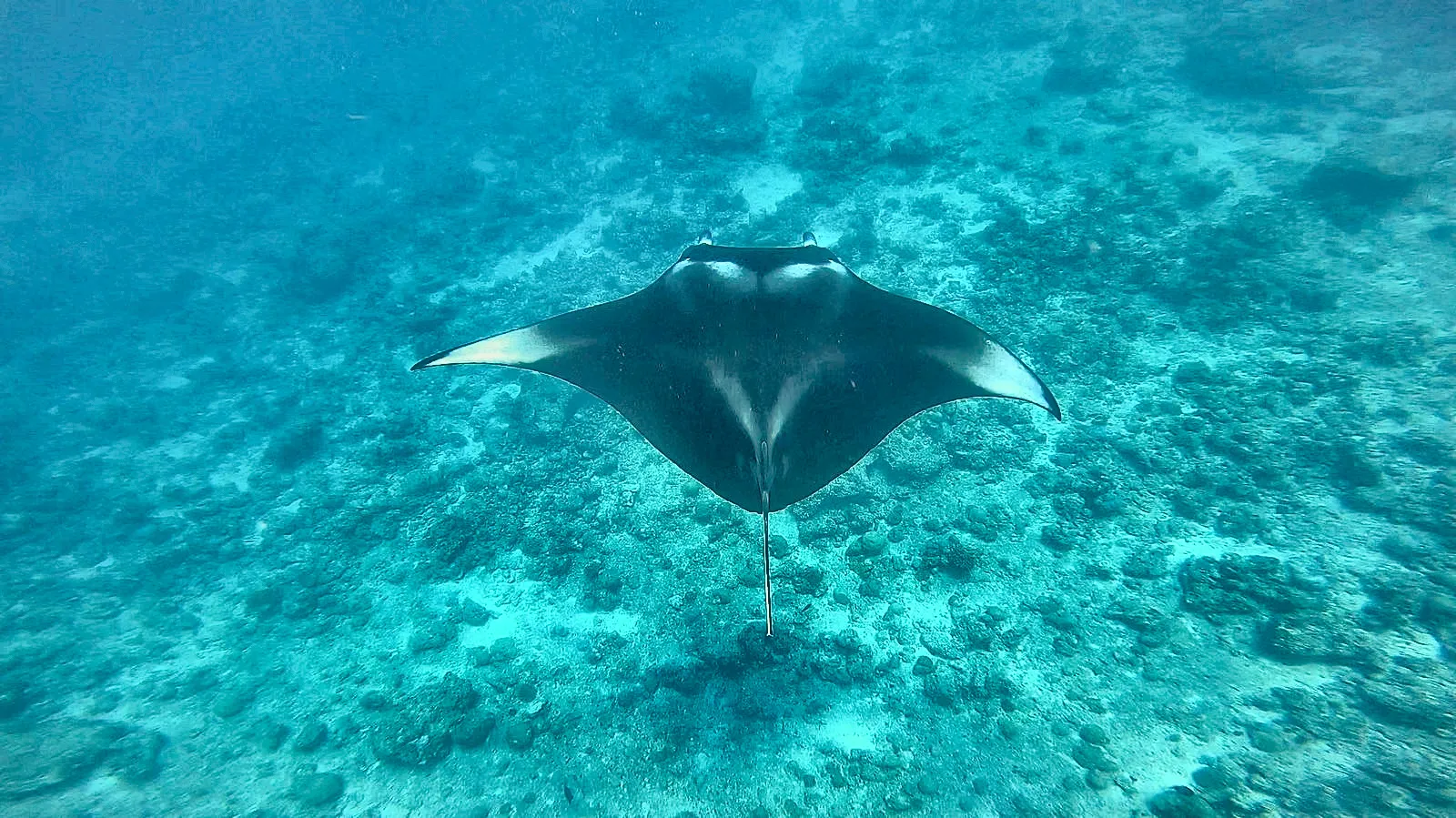
1. The back. From above you see two pale patches on the shoulders. On the giant manta they stand out sharply against the black, and the black between them forms a T. On the reef manta they fade out softly, and the black forms more of a Y.
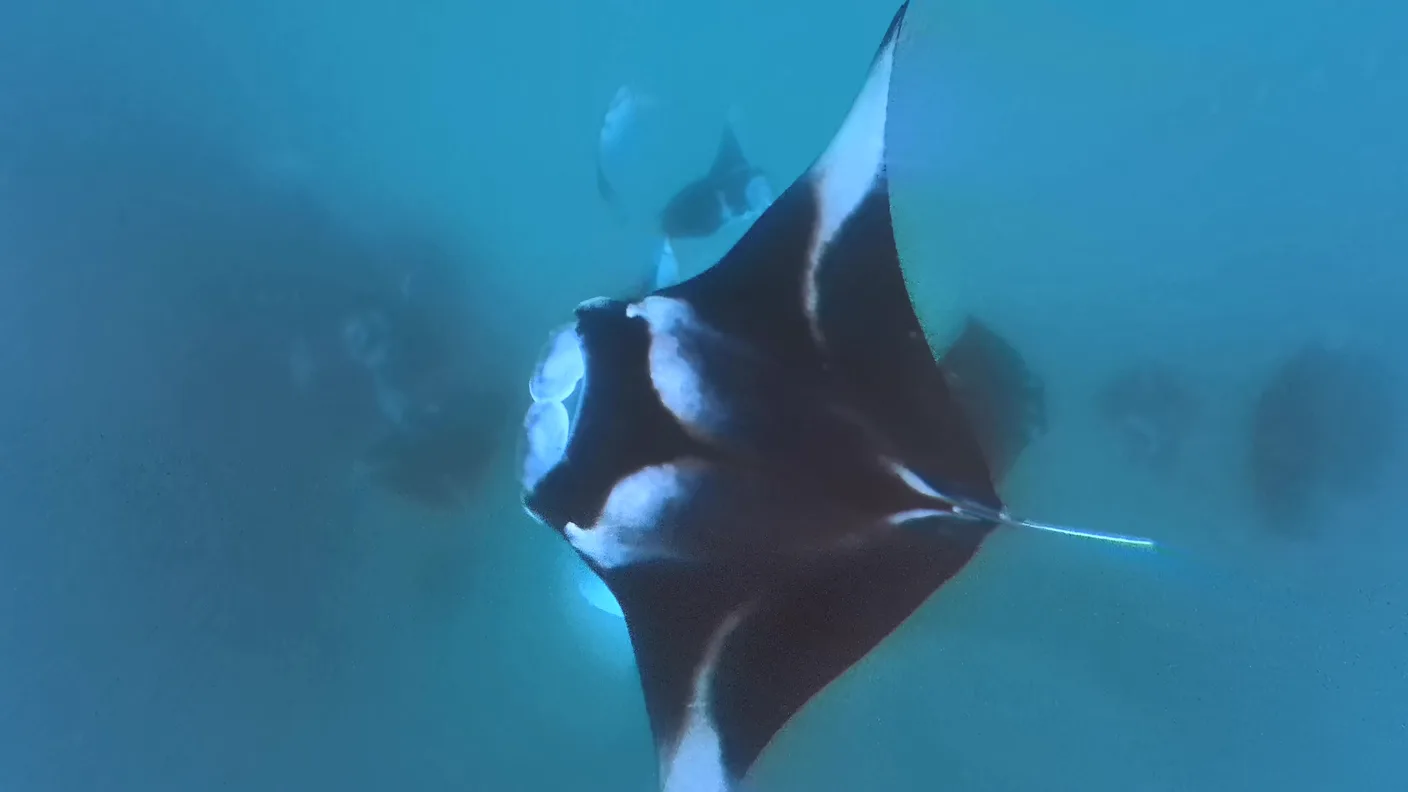
2. The mouth. Giant mantas often have a dark mouth and dark head fins. On the reef manta, the area around the mouth is usually white.
3. The belly. Every manta carries its own pattern of dark spots there. On the reef manta they usually also lie between the gill slits. On the giant manta that is rare, its spots sit farther back, and underneath, along the pectoral fins, it often has dark margins.
Then there is the location. Reef mantas stay at particular reefs and atolls all their lives, in shallow water near the coast. Giant mantas live out in the open ocean, in deeper water. Anyone who sees a manta on the house reef from the beach therefore has a good chance it is a reef manta.
Which manta rays feed in Hanifaru Bay?
The mantas show their bellies there on their own. With the guide’s permission I dive down, right in among the animals. All around me they move on in formation. I hold still. Any that come too close to me change course a little. Plankton makes the water dense, and the rain on the way there has stirred it up even more. Still, everything can be made out; some mantas are barely a meter away.
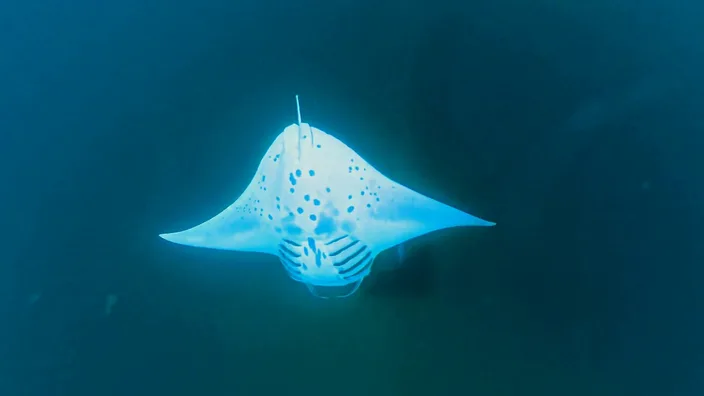
That is exactly what the still image shows: spots between the gill slits, the third look. And the 2021 study by Armstrong and others describes the bay as the place where the most reef mantas in the world gather, as far as is known. How the fifty animals moved around us that afternoon is told in the article about Hanifaru Bay. The animals come to feed: the tides hold dense clouds of plankton in the bay.
Four encounters, two names in the app
- Off Rasdhoo, boat trip, April 2025. In the app: no entry. On the image from above: pale shoulder patches that fade out softly toward the back.
- Cleaning station in Baa Atoll, August 13, 2026. In the app: giant manta, actually reef mantas. On the image: a white underside with the gill slits, spots not visible.
- Hanifaru Bay, August 14, 2026. In the app: giant manta, actually reef mantas. On the image: spots reaching in between the gill slits, softly fading shoulder patches.
- Rasdhoo house reef, August 18, 2026. In the app: reef manta. On the image: a manta, small at the reef edge.
I typed all three entries into the app myself.
The cleaning station in Baa Atoll was chance. On the way between two reefs, the boat stopped in open sea because mantas had been sighted there. We were in the water for a quarter of an hour, and I dove down.
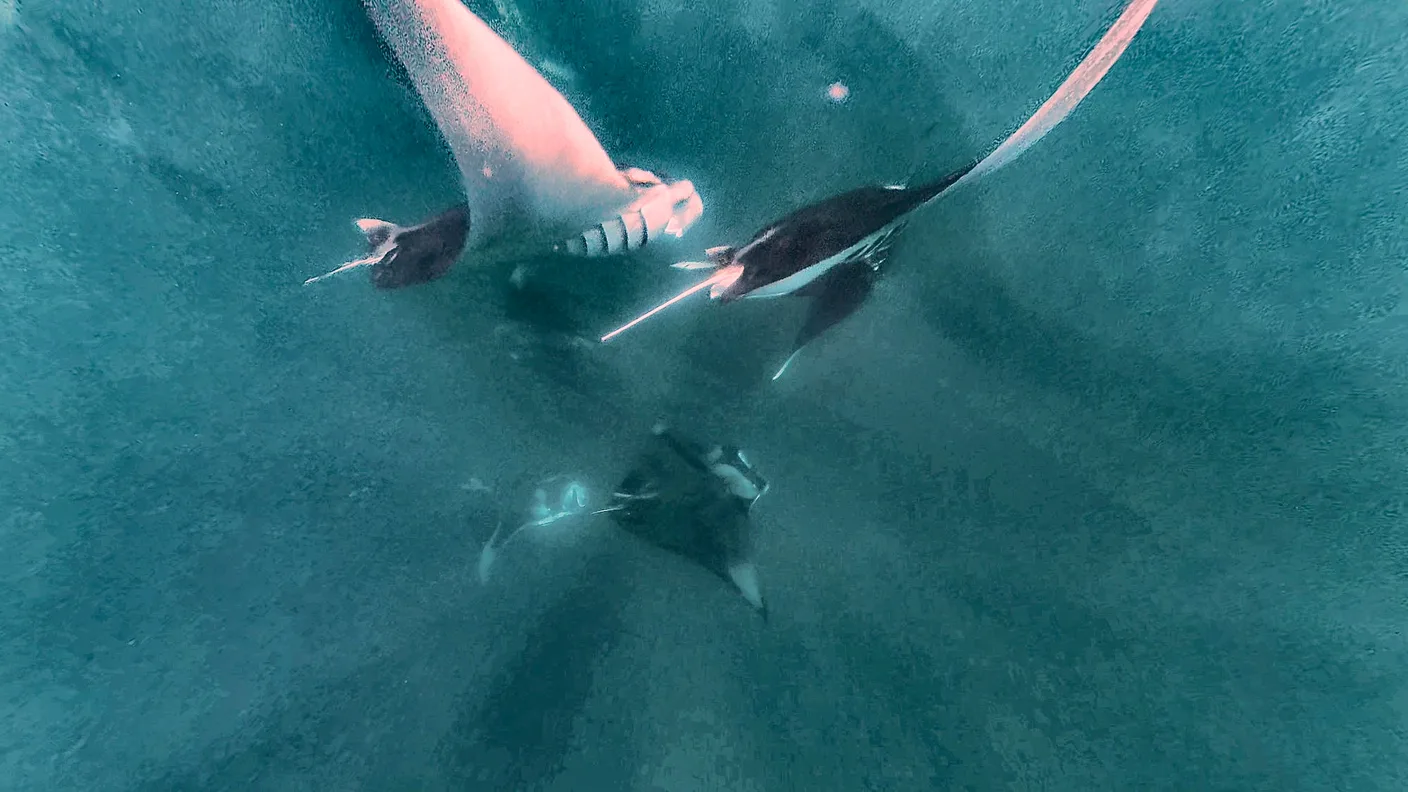
At a cleaning station, reef mantas can hover almost motionless over a coral block for minutes while small fish clean them. Divers should stay at the edge there and not swim over the cleaning spot, Visit Maldives advises.
On the house reef of Rasdhoo, it worked without a boat. From Bikini Beach you swim around fifty meters across the reef flat until the bottom drops away at the edge.
My wife and my son were in the water with me the first time. My son first found a moray eel and five minutes later the manta too. It passed around ten meters from us, for about thirty seconds. Afterward my son was really proud that he had seen it first, even before me.
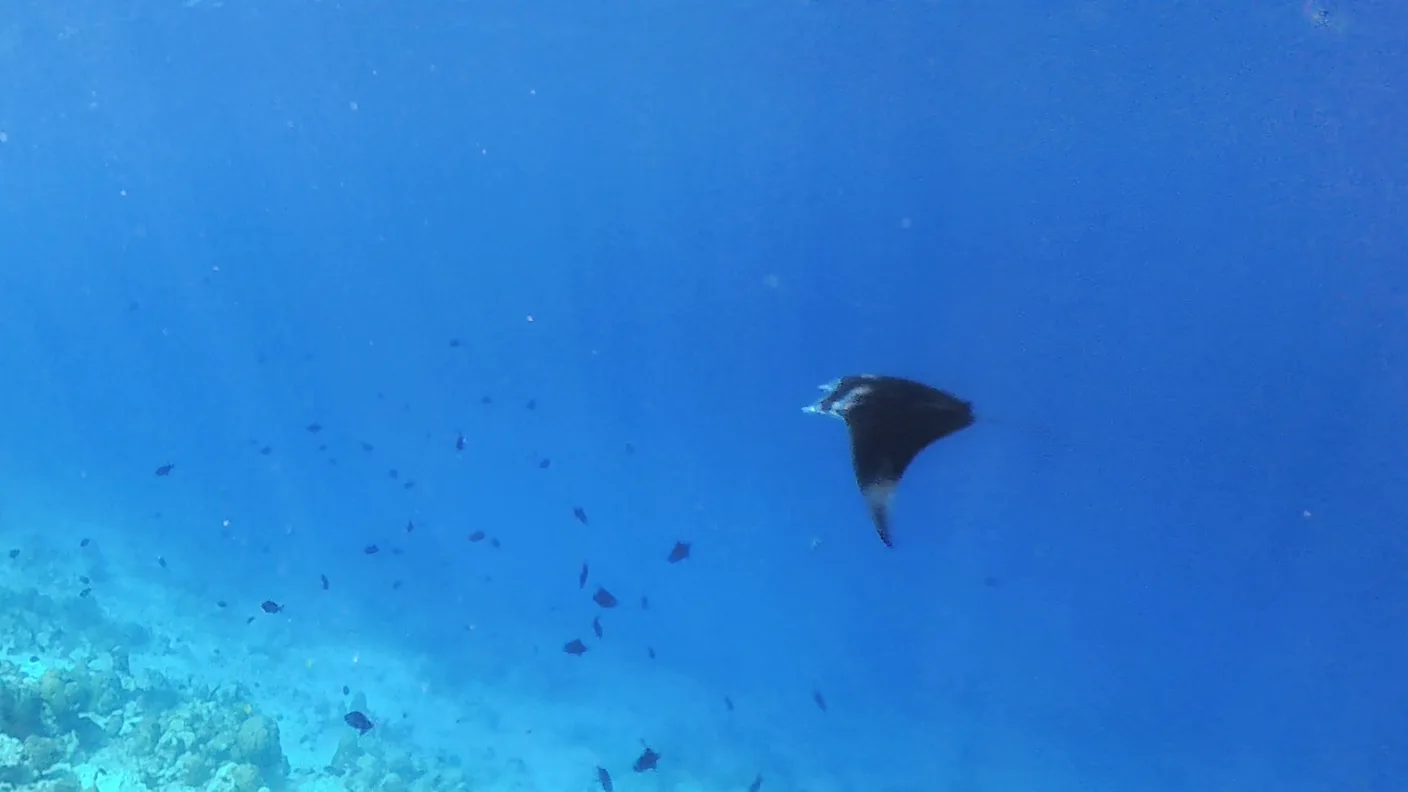
On the last morning on Rasdhoo, a reef manta passed by once more. This time only my wife was with me, and for my wife and me it was a wonderful ending.
Reef manta vs giant manta size: does it help?
Hardly. A reef manta grows up to around 4.5 meters wide; a giant manta usually measures four to five meters. The two sizes overlap.
My first manta, in April 2025 off Rasdhoo, seemed a good four meters wide to me. That fits both species.
How the whole day went is told in My first manta. The cover image says more than the size: it shows this manta from above, with two pale shoulder patches that fade out softly toward the back. I don’t have a picture of the belly.
Where are there giant mantas in the Maldives?
Mainly off Fuvahmulah, in the far south. Over 85 percent of all giant manta sightings come from this one atoll, reports the Manta Trust. Visit Maldives names the months of March to May for this. We have never been there.
According to the Manta Trust, the Maldives are home to the largest group of reef mantas recorded so far worldwide, plus the third largest of giant mantas. Each manta is recognized by its belly. The pattern of spots stays the same for life, like a fingerprint. The images for this come from dive centers, hobby researchers and marine biologists who dive down beneath a manta and photograph it from below.
My conclusion
If you see a manta in the Maldives, look first at the back while it is below you, and then at the belly when it turns. And film it if you can. With the 360-degree camera I sometimes found out later that around the one manta I wanted to film, five others were swimming too.
The Napoleon wrasse from the Rasdhoo house reef will get an article of its own.
Frequently asked questions
Is a giant manta dangerous, does it have a stinger? No. Mantas have no stinging tail like stingrays or the related devil rays. The giant manta only has a knobby thickening at the base of its tail. The reef mantas in Hanifaru Bay were sometimes barely a meter away from us; none of them touched us.
Mantas with children: does that work? Yes, as long as they can swim safely or go into the water with a vest. Mantas don’t harm people, and the guides could be relied on everywhere. On the house reef of Rasdhoo, our son spotted the manta first. On the Hanifaru tour he stayed on board. His mosquito bites were scratched open, and the salt water stung in them too much. So bring mosquito protection: something against new bites and something for the ones that come anyway.
When can you see mantas in the Maldives? All year round. With the monsoon, the reef mantas switch sides of the atolls: from December to March more in the west, from April to November more in the east. Hanifaru Bay has its season from May to December. Off Rasdhoo we had to search for the manta by boat in April; in August one passed the house reef every morning.
Where the information comes from: Features and wingspans from the Manta Trust and the Maldives Manta Conservation Programme, belly and tail base according to the species description by Marshall and others (2009), summarized in the English Wikipedia (reef manta, giant manta). The reef mantas of Hanifaru Bay from the study by Armstrong and others (2021, PeerJ), the numbers of recorded animals from the Manta Trust (reef mantas, June 2024, giant mantas), the behavior at cleaning stations from the same Wikipedia page on the reef manta, the white mouth of the reef manta from the information site Manta Ray Advocates Hawaii, the months off Fuvahmulah, the Hanifaru season and the rule for divers at cleaning stations from Visit Maldives, the monsoon sides from Harris and Stevens (2021). Sources as of September 25, 2026. Our own encounters: Rasdhoo in spring 2025, Baa Atoll and Rasdhoo once more in summer 2026.
Further reading
- Hanifaru Bay: season, how it works and the rules in the bay
- My first manta: out by boat, when none came by the house reef
- Rasdhoo: the house reef with the manta in the morning
- Maalhos: starting point for Hanifaru Bay and the cleaning station
- Visibility when snorkeling: why the water off Rasdhoo got murkier at midday
- Maldives destination guide: rainy season, dry season and our islands