Travel report
Hanifaru Bay manta season in the Maldives: fifty mantas in the water
Translated from the German original.
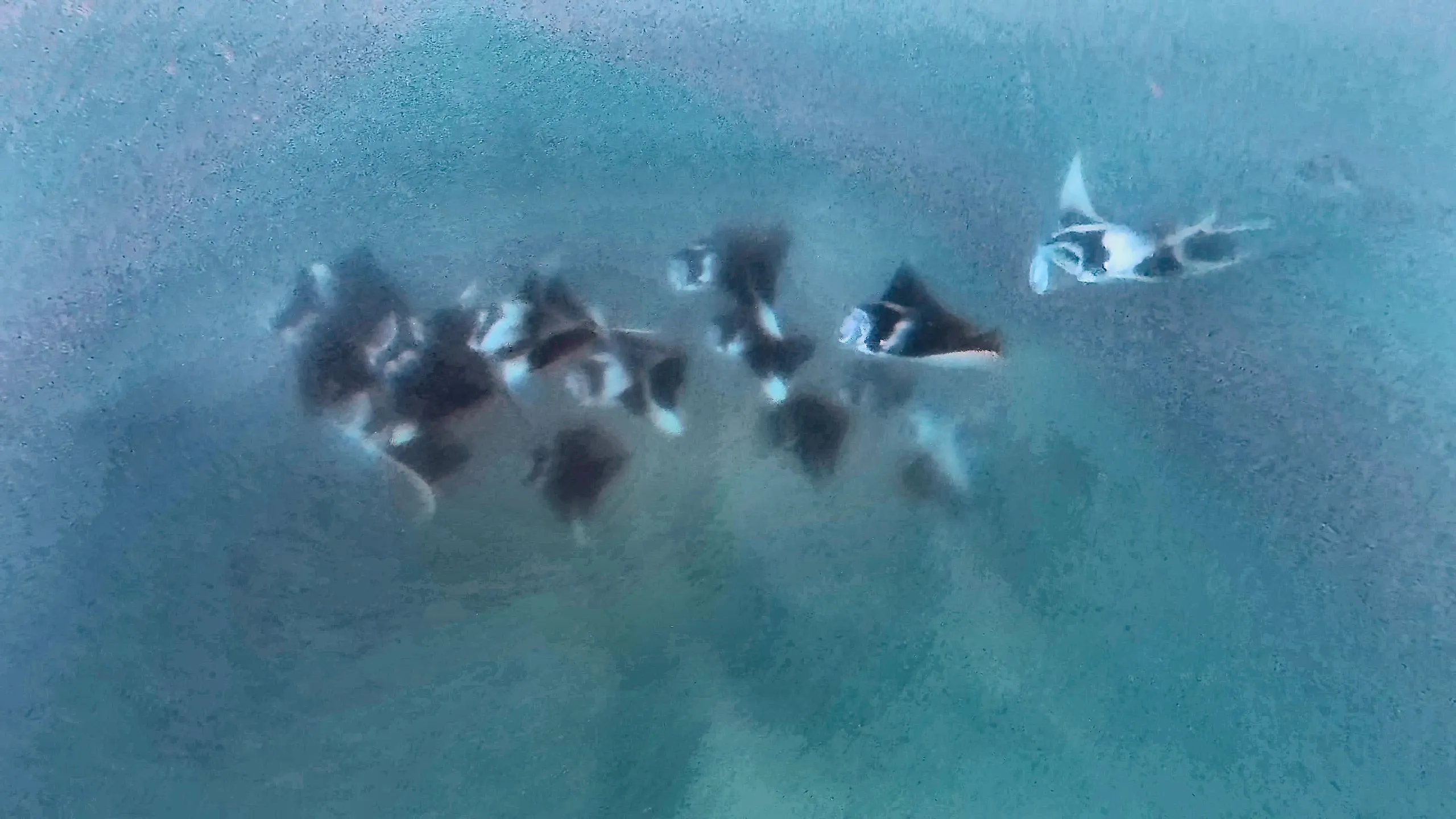
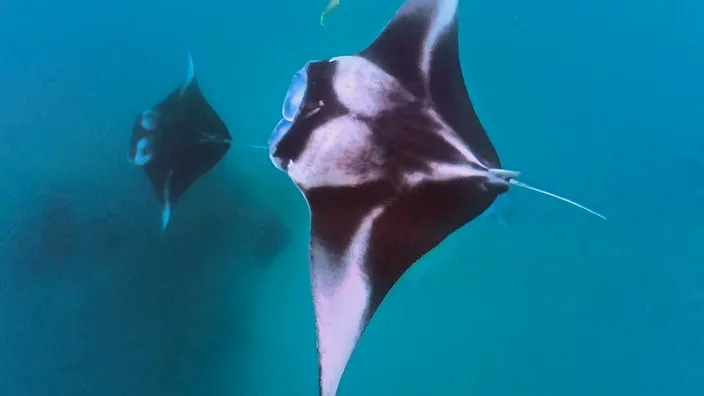
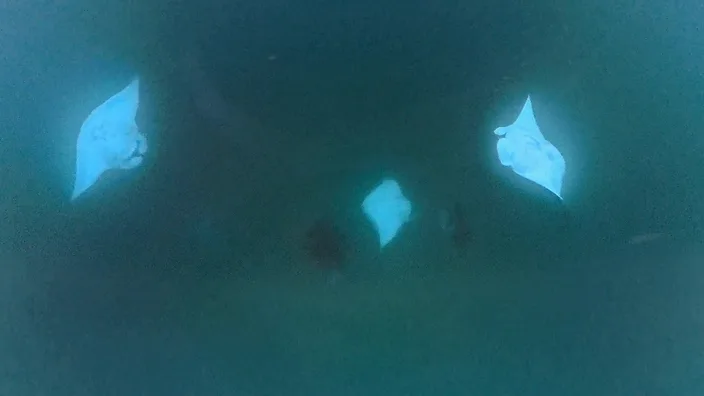
First a little way along the surface, and then you see the first mantas, and you’re already happy. After that more and more, in formation flight beneath you, loops right below. I see the pale underside and pull my arms and legs in to my body, because they come so close that otherwise I’d be in the way.
Then I dive down, into the middle of the group. The guide allowed it. I keep still, I’m simply there, and the huge animals steer around me. Never hurried, a small change of course, that’s all. Two swim toward each other and at the last moment both do a loop. There isn’t more than five centimeters of space between them.
When is manta season in Hanifaru Bay? From May to November; the largest gatherings come from July to October, and within the season the days around the full and new moon are the strongest. We were there on August 14, 2026, and had around fifty mantas in the worst visibility of the whole trip. The two go together: in Hanifaru Bay, murky water is the sign that there is food, and with the food come the mantas. If you want to see mantas in the Maldives, you should plan in this afternoon.
At a glance
| Where | Hanifaru Bay in Baa Atoll, Maldives; the whole atoll is a UNESCO biosphere reserve |
| Getting there | around 20 minutes by boat from Maalhos, a local island in the same atoll |
| Season | May to November, the largest gatherings July to October (Snorkeling Report, as of 05/2024); strongest around the full and new moon |
| Getting in | from the boat; you snorkel at the surface; diving is prohibited, brief dives down only after agreeing with the guide |
| Time in the water | 45 minutes at most |
| Supervision | rangers; at most 80 snorkelers are allowed in the water at the same time (the government’s management plan) |
| Prohibited | diving, extension poles on the camera, touching |
| Price from Maalhos | not noted; excursions there sometimes half as expensive as on the other islands (2026) |
| Price from Kamadhoo | 144 US dollars per person for two hours, from two people, plus 17% tax and 10% service charge (according to the accommodation’s price list, August 2026) |
| For whom | anyone who floats confidently with mask and snorkel, children too |
| Our day | August 14, 2026, 4 p.m.: around 50 mantas, visibility around 10 meters, lots of plankton, 2 meters depth |
Contents
- Why is the water in Hanifaru Bay so murky?
- How to get to Hanifaru Bay
- How close do the manta rays come?
- How crowded is Hanifaru Bay?
- Best time to see mantas in Hanifaru Bay
- Hanifaru Bay price: what does the tour cost?
- Can you visit Hanifaru Bay with kids?
- Are there manta rays outside Hanifaru Bay?
- My conclusion
- Frequently asked questions
Why is the water in Hanifaru Bay so murky?
It was the experience of the whole trip, and the trip had plenty to offer. The astonishing part: at around ten meters, the visibility was one of the worst I had in those two and a half weeks.
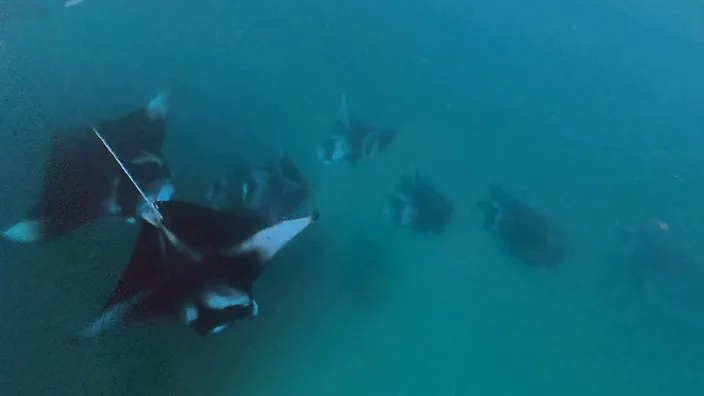
There was so much plankton in the water in the bay that it was visibly murky. The heavy rain on the way out had churned up the sea even more. And this very plankton is the reason the animals are there. The tides push it into the bay, and the mantas come to feed. Clear water in Hanifaru Bay would mean: no plankton. And no plankton would mean: no mantas.
So if you read that the visibility there is moderate, you’ve been told the right thing. It’s just no reason to stay away. On the reefs that same week, the visibility was twenty meters and more. How differently that turns out on a single trip is in the article about poor visibility while snorkeling.
How to get to Hanifaru Bay
We stayed on Maalhos, a small local island in Baa Atoll in the Maldives, not in a resort. For the bay, that is an advantage. The ride takes only twenty minutes, and half the day isn’t gone.
We set off in the afternoon, the sky overcast, and we had barely left the harbor of Maalhos when it started to rain. But you’re in the Maldives to get wet anyway, and it wasn’t cold either.
Then we reach the bay. The boats come in very slowly, so that no animals get hurt. They come up to just below the surface. Anyone who came in here at speed would run right over a manta’s back. From above, you can’t see much of the bay. What makes it special stays invisible as long as you don’t put your face in the water.
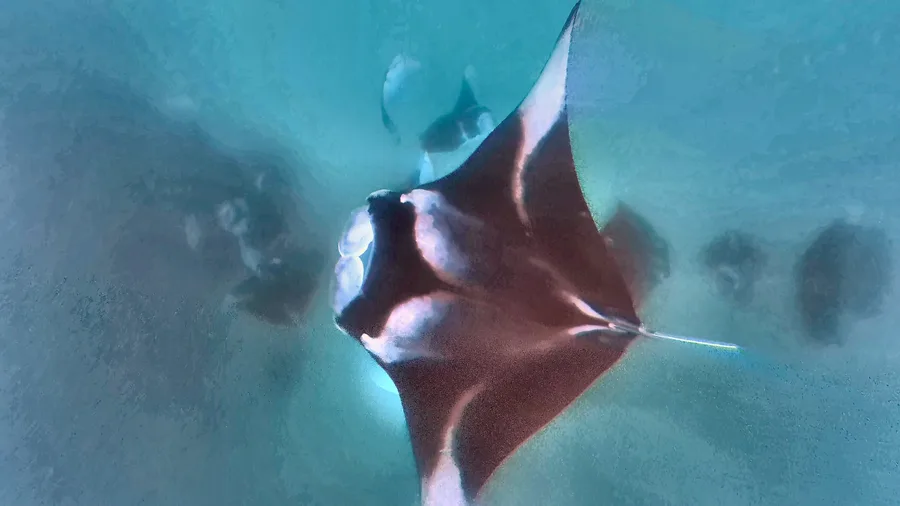
On the way through the bay we get our briefing: no extension poles on the camera, no touching, and always stay with the guide. The last two points are normal. The thing about the pole sounded like bureaucracy to me beforehand.
How close do the manta rays come?
So close that, in the water, the thing about the pole made sense to me within the first minute. A stick that moves a meter ahead of you will hit something sooner or later. You don’t get the feeling that you’re disturbing the animals. They move along their paths as if nobody were there.
Sometimes it seems as if they had made a plan together for how to plow through the sea systematically for food. They almost always swim in formation; only rarely is an animal on its own.
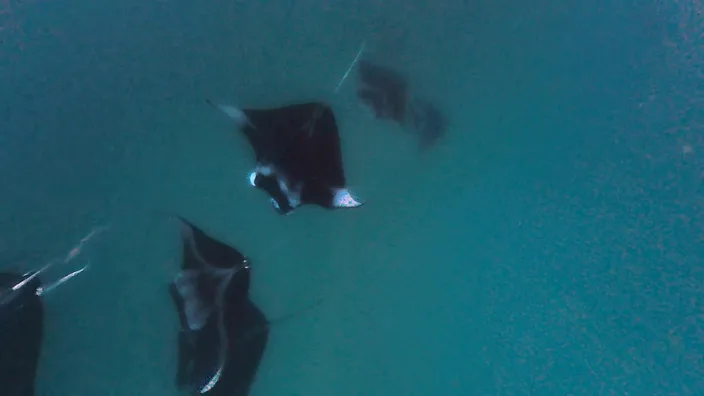
We were in the water for thirty to forty minutes, and there were maybe two minutes when I had no manta in sight. There must have been fifty animals in the bay.
For the camera, that means: it belongs in your hand or on a short grip, not on an extension. What I use is listed under my gear. You don’t need many accessories here anyway; the animals sometimes come within barely a meter.
How crowded is Hanifaru Bay?
Everything is monitored by rangers, and I think that’s very good. At most eighty snorkelers are allowed in the water at the same time, and one day it’s the resorts’ turn, the next day the local islands’.
Because the bay is large, it spreads out. There isn’t the chaos I had experienced eight days earlier with the whale sharks off Dhigurah, in South Ari Atoll. There, fifty of us snorkelers were chasing a single animal. That was not a nice experience.
The difference between the two days is the regulation. How things go at other fixed spots is covered in the nurse shark tour off Fulidhoo and at Turtle Reef off Rasdhoo.
Still, it isn’t quiet in Hanifaru Bay. You share the bay with others, you keep to a clock, and you get counted. I didn’t feel that as a restriction for a single second. A lonely reef it is not.
Best time to see mantas in Hanifaru Bay
Around the full and new moon, the tides run strongest and push the most plankton into the bay. If you can time your trip, put your Hanifaru day in this window.
Around the full moon, you also have a good chance of seeing whale sharks in the bay. That is my tip for the bay. We were there in mid-August and didn’t see any.
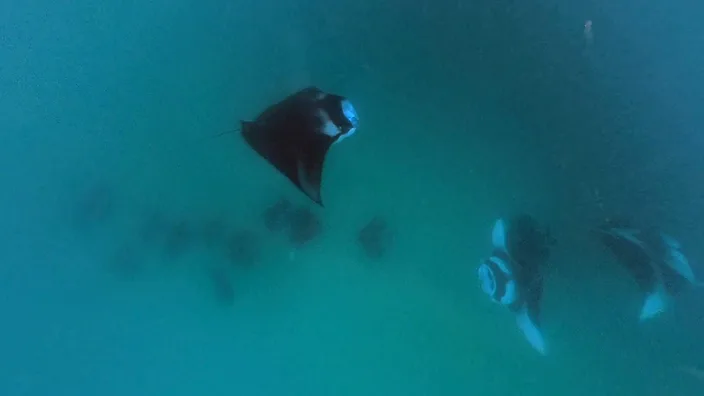
None of this is a guarantee. We had an afternoon with fifty animals; there are days with two and days with none.
Hanifaru Bay price: what does the tour cost?
From Maalhos, the trip was on our accommodation’s price list at 70 US dollars per person (August 2026). For two adults and our son, we paid 150 euros together. It was cheaper because our son stayed in the boat: the fee for the protected area is only paid by those who go into the water. For comparison, the neighboring island: from Kamadhoo, also in Baa Atoll, the Hanifaru tour cost, according to the accommodation’s price list in August 2026, 144 US dollars per person for two hours, from two people. On top of that came 17 percent tax and 10 percent service charge.
We did most of the excursions of this trip on Maalhos, and that had a solid reason. The prices there were sometimes only half as high as on the other islands. The whale shark tour from Dhigurah, for example, cost ninety US dollars per adult and forty-five for the child.
Staying close to the bay saved us time above all: the trip cost one afternoon, not a whole day.
Can you visit Hanifaru Bay with kids?
Yes, if they swim confidently or wear a vest. The mantas are harmless, and we found the guides reliable. You snorkel at the surface; nobody has to go deep, the animals come up from below.
Our son stayed in the boat that day anyway, and not out of fear of the mantas. He had scratched mosquito bites, and the salt water stung too much. So pack mosquito repellent, something against the bites and something for afterwards. In return, on the way back he got to steer the boat, the whole way from Hanifaru back to Maalhos. The captain gave him big praise. His highlight of the day was the steering wheel.
That’s part of the Maldives with children: what is the highlight for adults doesn’t have to be one for a child. On Kamadhoo, the reef begins thirty meters off the beach. There, children and adults have their experience right in front of the beach: short distances, no boat. And whoever has had enough simply gets out.
Are there manta rays outside Hanifaru Bay?
Yes, throughout Baa Atoll. The day before Hanifaru Bay, we were out on a two-reef tour. On the way from one reef to the other, the boat stopped in the middle of the open sea. Mantas had been sighted at a cleaning station. We went in and really did see a reef manta, for a quarter of an hour.
That was chance, not something we had booked. A cleaning station is something different from a plankton field: there the mantas hold still and let small fish clean them, instead of feeding.
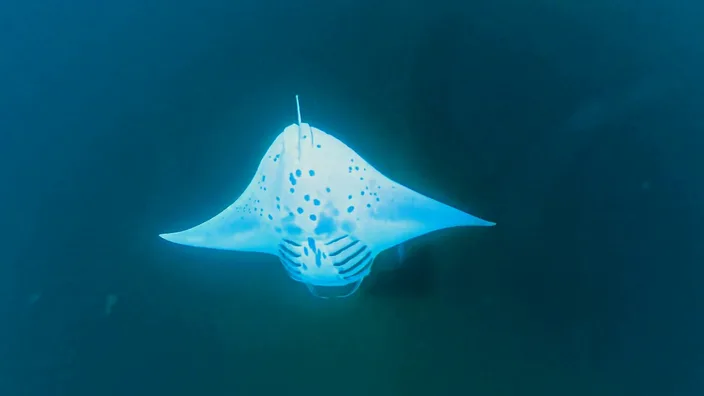
By the way, I saw my very first manta a year earlier off Rasdhoo. A single animal, and afterwards I was unreachable for days. Fifty at once is a different order of magnitude, but the first remains the first.
My conclusion
Plan in Hanifaru Bay if you’re in the Maldives between May and November, and stay in Baa Atoll for it. Take a boat from an island nearby, and the bay will cost you one afternoon, not a whole day. And if you can arrange it, go around the full moon.
Frequently asked questions
When is manta season in Hanifaru Bay?
From May to November; most of the animals come from July to October. It is strongest around the full and new moon, when the tides push the most plankton into the bay. We had around fifty mantas in mid-August.
Can you dive in Hanifaru Bay?
No, diving is prohibited. You snorkel at the surface, for 45 minutes at most and under the supervision of rangers. I was only allowed to dive down briefly after agreeing with the guide.
How many mantas do you see in Hanifaru Bay?
For us it was around fifty, and there were maybe two minutes when I had none in sight. There is no guarantee; there are also days with few animals or none.
Are there whale sharks in Hanifaru Bay?
During the season, whale sharks also come into the bay; the chances are best around the full moon. We didn’t see any in mid-August.
How do I get to Hanifaru Bay?
With an excursion boat from an island in Baa Atoll. From Maalhos, the ride takes around twenty minutes.
Where the rules come from: The eighty snorkelers, the forty-five minutes and the diving ban are in the Maldivian government’s management plan for Hanifaru Bay (2025–2030) (accessed in September 2026).
Where the season details come from: The months are given by the Snorkeling Report on Hanifaru Bay (as of May 2024). That the mantas feed on tide-driven plankton fields has been studied; I only saw it: study on Hanifaru Bay (PeerJ 2021, PMC) and environmental factors of manta visits in the Maldives (PMC). All the islands of this trip are in the Maldives destination guide.
Which island in the Maldives is best for snorkeling, I will tell in an article of its own.