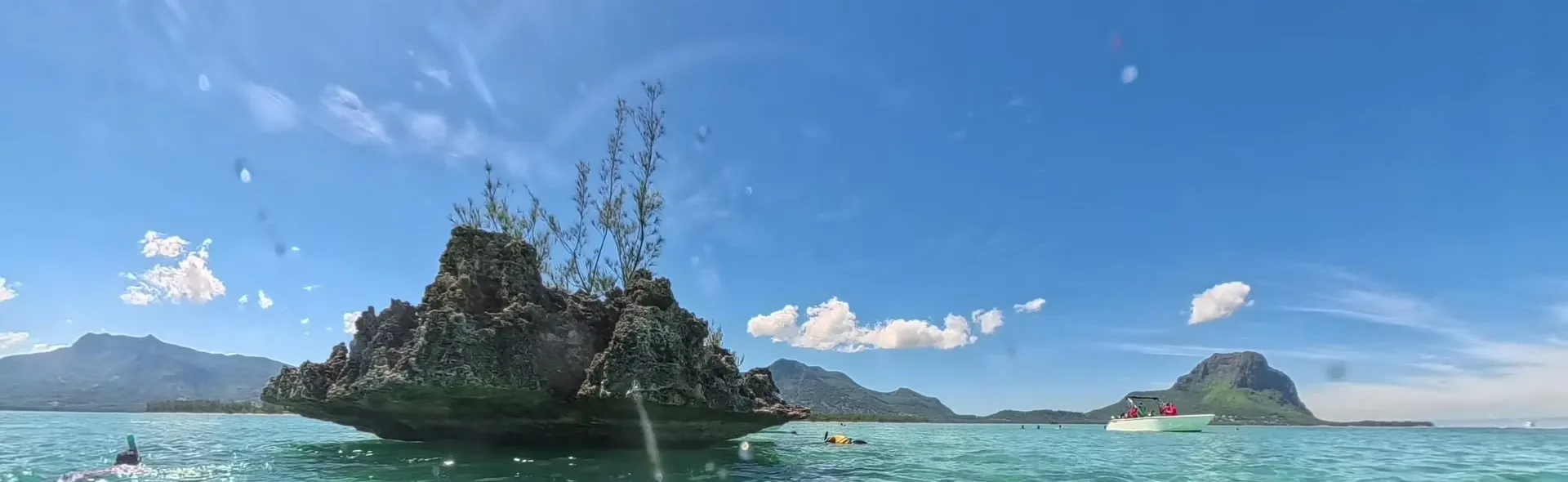
Indian Ocean
Snorkeling in Mauritius: my experience and the best time
- West coast
- many spots by boat
- 27 degrees on average in February
- best time: second half of May
In short Off Flic en Flac there is sand and gray coral rubble – many of the spots worth visiting are reached by boat.
Translated from the German original.
While snorkeling I estimated visibility, water temperature and depth, just as I experienced them on the days I was there. On dives the dive computer measured depth and duration, and values with a named source show what is usual there, not how it was for me.
Now in November
Early summer — the cyclone season begins
- Water
- 24 °C in November, 25 °C in December
The water gets warmer again, and on November 1 the cyclone season begins. We haven't experienced these months ourselves.
Source: Water: German Weather Service, climate table for Plaisance. Cyclone season: Meteorological Services Mauritius (both retrieved September 28, 2026)
The year at a glance
| Months | Season | Water | Visibility | To see |
|---|---|---|---|---|
| January–March | Southern summer — warmest water, cyclone season | 27 °C on average | February 2026 around 20 m (own estimate, Flic en Flac) | Damselfish in the lagoon, colorful fish at the coral stop of the boat trip, dolphins on the west coast |
| April–May | Transition — the water stays warm | 27 °C in April, 25 °C in May | — | — |
| June–October | Southern winter — cooler water, humpback whales | 22–24 °C (coolest in August) | — | Humpback whales from July to October for calving and nursing |
| November–December | Early summer — the cyclone season begins | 24 °C in November, 25 °C in December | — | — |
There is a reef all around Mauritius, and yet in front of our hotel beach in Flic en Flac we found mostly sand and gray coral rubble. I hadn’t expected that. Then the trip that was supposed to take us to a spot considered the best on the island was called off as well. The weather was to blame.
Snorkeling in Mauritius meant two things for us on the west coast: from the beach into a shallow, calm lagoon, and by boat to clear water over corals. For a warm, relaxed day in the sea you don’t need a boat; for a colorful reef you do. We mainly had to be careful at the surf wall at the front of the lagoon, and in February the weather had a say in which trip went ahead.
Where we stayed: in Flic en Flac, close to the beach.
See places to stay in Flic en Flac (Advertisement)
At a glance
| Where I was | West coast, Flic en Flac, early February 2026: the lagoon at the hotel beach, Turtle Point, a boat trip to the southwest; plus a day trip to the southeast to the wreck of the Dalblair off Blue Bay |
| From the beach | lagoon over sand and coral rubble, at most 2 m at the surf wall at the front |
| By boat | coral stop down to about 4 m, clear water (February 1, 2026) |
| Water | 27 °C in February on average; January to April 27 °C, August 22 °C (German Weather Service, Plaisance station) |
| Cyclone season | November 1 to May 15 (Mauritius weather service) |
| Turtles | one at Turtle Point; swimming with them, feeding and harassing them prohibited, notice from January 2022 |
| Dolphins | a group of around twenty on the boat trip; swimming with them only allowed from 6 a.m. to 12 noon, at most three swimmers per boat in the water at once, life-saver included (regulations of 2012) |
| Humpback whales | July to October (IUCN), not seen ourselves |
Contents
When is the best time to snorkel in Mauritius?
For warm water outside the cyclone season, the second half of May makes sense: according to the Mauritius weather service, the cyclone season ends on May 15, and in May the sea still averages 25 °C. If you want to see humpback whales, come from July to October and accept 22 to 23 °C. According to the International Union for Conservation of Nature (IUCN), that’s when they give birth to their young in the waters around Mauritius. The 2012 regulations prohibit swimming with whales. We were there in February. The lagoon was calm; on one morning the water was still cold.
The German Weather Service lists the island’s water temperatures for Plaisance in the southeast:
| Month | Water |
|---|---|
| January | 27 °C |
| February | 27 °C |
| March | 27 °C |
| April | 27 °C |
| May | 25 °C |
| June | 24 °C |
| July | 23 °C |
| August | 22 °C |
| September | 23 °C |
| October | 23 °C |
| November | 24 °C |
| December | 25 °C |
Where is the best snorkeling in Mauritius?
The most convenient part is right on your doorstep. You walk from the hotel to the beach and in. Underwater, over long stretches, lies gray rubble where a great many damselfish live. Only at the surf wall do lionfish hover under the rocks, and the fish get more colorful. What you need there is in the report from the hotel beach in Flic en Flac, together with the way out to the wall.
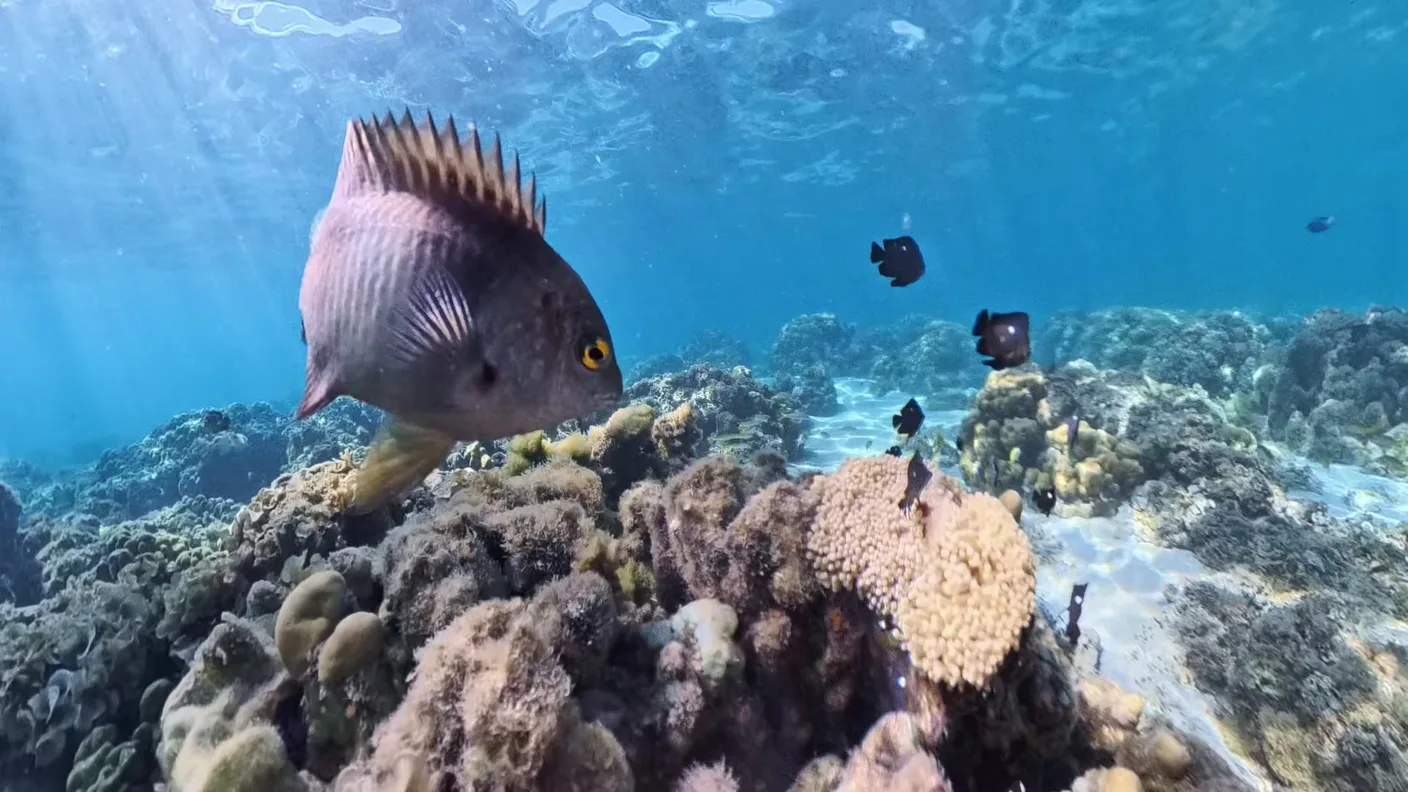
Even so, the most beautiful moment of the whole trip came from the shallow water. At Turtle Point there was a large sea turtle in the shallows, with many snorkelers around it. We got there on a booked trip; swimming would have worked too. We kept our distance and waited. After ten minutes it passed by me, less than an arm’s length below me, in barely two meters of water.
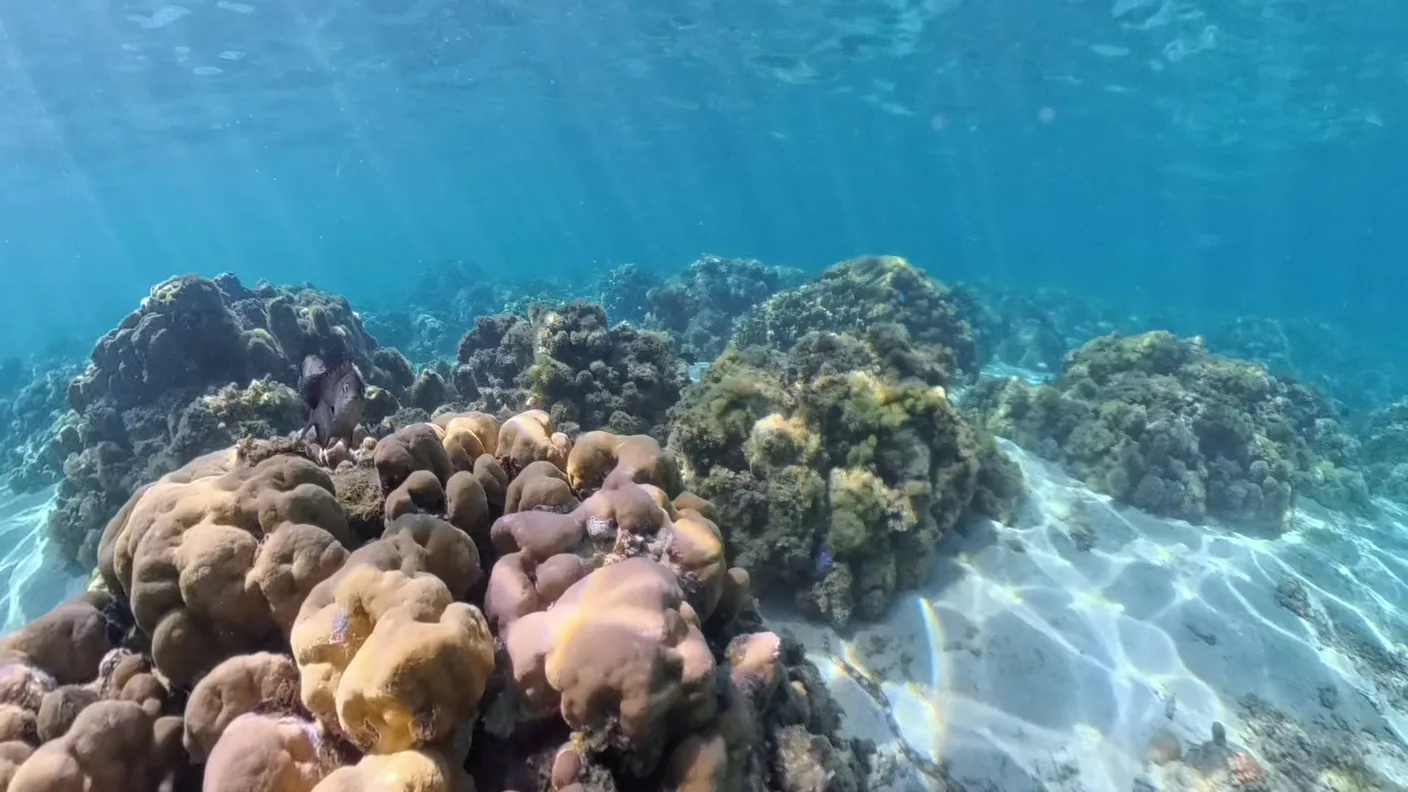
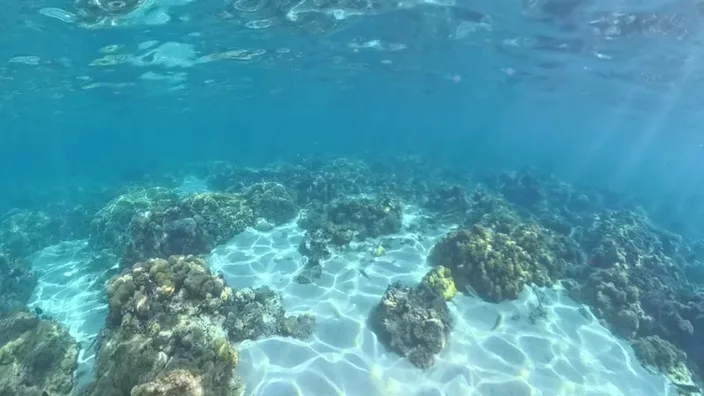
It was more colorful than in the lagoon at the coral stop of our boat trip to the southwest. Where gray rubble lay in the lagoon, round coral domes stood here, and between them, at last, colorful fish. The water was clearer. We stayed there for half an hour, around four meters deep at the deepest point. Then we went on to the Crystal Rock, the rock from the cover photo. It stands on a sandy bottom; we only looked at it.
Which coast of Mauritius is best for snorkeling?
Here we mainly describe the west coast. That’s where we stayed, and that’s where the trip to Turtle Point and the boat trip to the southwest started. Many travel sites name the north around Trou aux Biches or Blue Bay in the southeast for snorkelers. We weren’t in the north; Balaclava Marine Park has been there since 2000. We went to the southeast on a day trip and snorkeled for about thirty minutes at the wreck of the Dalblair off Blue Bay. It was impressive. The bay has been a marine park since June 2000 and is known for its corals.
Is it safe to snorkel in Mauritius?
In the lagoon off Flic en Flac it was calm for us. Close to the beach you could stand, and there was no real current there, just the movement of the waves. We had to watch out further out at the surf wall, because of the current on the way there and the coral just below the surface. Fins are a must there, because you swim a good distance out. You can read more about the lagoon in February in the travel report Mauritius in February.
Off the coast, the German Federal Foreign Office warns of strong, constantly changing undercurrents. It advises staying in the marked swimming zones, never snorkeling alone and wearing water shoes, on the beach as well as in the water. In the shallows, venomous stonefish can also hide between sand and stones. I would definitely pack water shoes, because of the coral rubble in the shallow water.
Off Flic en Flac the waves break far out, and on the long way to the wall the current pushes, sometimes with you, sometimes against you. Fins are a must here, because you swim a good distance out. Without them it gets tiring, and if in doubt you don’t end up where you wanted to go.
At the surf wall at the front there are at most two meters of water. The sharp corals stand just below the surface, and there’s little room to move out of the way. Anyone who props themselves up there damages the coral and cuts themselves on it. Neoprene shoes protect your feet. You shouldn’t prop yourself up anywhere there, not even on the rocks with lionfish hovering underneath.
Do you need a boat to snorkel in Mauritius?
Not for the lagoon. You walk in from the beach whenever you like. For the colorful part we needed one. We had booked the boat trip to the southwest with a small tour operator on the promenade, on the way to the beach. Around ten guests were on board, and the speedboat ran down the coast for three quarters of an hour, in calm seas and with Le Morne in view.
On the way out, before the coral stop, the boat stopped at a group of dolphins, about twenty animals, probably with young ones. We were all in the water. The dolphins kept their distance. We could hear them before they dove beneath us. No rules were mentioned on board. The 2012 regulations allow swimming with dolphins only between six in the morning and twelve noon, with at most three swimmers per boat in the water at the same time, the life-saver included. If you book a boat trip with a dolphin stop, it’s best to ask beforehand how the operator handles this.
Anyone who wants to enjoy the island should bring shoes suited for hiking. The terrain is partly difficult and not for flip-flops or slippery sneakers. For hiking tours, ask about the difficulty beforehand; some could be too demanding for children.
My conclusion
If you book for the snorkeling, plan the boat trips in beforehand and hope the weather plays along. Above water, Mauritius is worth the trip, with its landscape, its people and its food. What stayed with me are the turtle at Turtle Point and the half hour over the domes.
Frequently asked questions
When is the best time to snorkel in Mauritius? For warm water outside the cyclone season, the second half of May. If you want to see humpback whales, come from July to October. We were there in February; on one morning the water was still cold and we were freezing after the first snorkel.
Is snorkeling in Mauritius dangerous? Off Flic en Flac you mainly have to be careful at the surf wall at the front, where sharp corals stand just below the surface, and on the way there because of the current. The German Federal Foreign Office advises never snorkeling alone. During the cyclone season the weather decides whether a boat trip goes out.
Where is the best snorkeling in Mauritius? We found the clearest water and the most colorful fish at the coral stop of a boat trip from Flic en Flac. From the beach, the surf wall is worth it.
Can you snorkel in Mauritius without a boat? Yes, in the lagoon straight from the beach. What you mainly see there are damselfish over coral rubble, and at the wall lionfish too. You can also reach Turtle Point by swimming.
How warm is the water in Mauritius in August? On average 22 °C, cooler than in any other month (German Weather Service, Plaisance). In February it averages 27 °C.
Are sea turtles protected in Mauritius? Yes. Swimming with turtles, feeding and harassing them are prohibited; that is what a notice from the Ministry of Fisheries from January 2022 says, which the Tourism Authority also shows. You don’t follow them, and you leave the way up clear.
Sources
Evidence for everything here that I didn’t experience myself. As of September 28, 2026.
- Turtles: Turtle ban of January 2022 on the Tourism Authority’s website
- Cyclone season: Mauritius weather service (MMS), report on the cyclone season
- Marine parks Blue Bay and Balaclava: Ministry of Fisheries of Mauritius, Marine Conservation Division (accessed on 14.10.2026)
- Water temperatures: German Weather Service climate table for Plaisance; Plaisance is in the southeast, the west coast may differ
- Dolphins: Tourism Authority (Dolphin and Whale Watching) Regulations 2012, GN No. 154 of 2012, amended by GN No. 228 of 2012, accessed on October 8, 2026
- Humpback whales: IUCN fact sheet on Mauritius and its neighboring islands
- Currents, stonefish, water shoes: German Federal Foreign Office, travel and safety advice for Mauritius
Further reading
- The turtle at Turtle Point: ten minutes of patience and what has applied since 2022
- Boat trip to the Crystal Rock: speedboat, dolphins, coral stop
- Flic en Flac page: visibility and depth at all three spots, each with the day
- Maldives: islands with the reef right in front of the beach
- Maldives or Mauritius for snorkeling?: reef edge, lagoon and boat tours compared
- Mauritius in February: water, rain by coast and the wind
- My snorkeling gear: what I take and what cheap gear covers
- Visibility: how clear the water was at the places, with the day