Tips
Best snorkeling in Sharm El Sheikh: four Red Sea reefs for beginners
Translated from the German original.
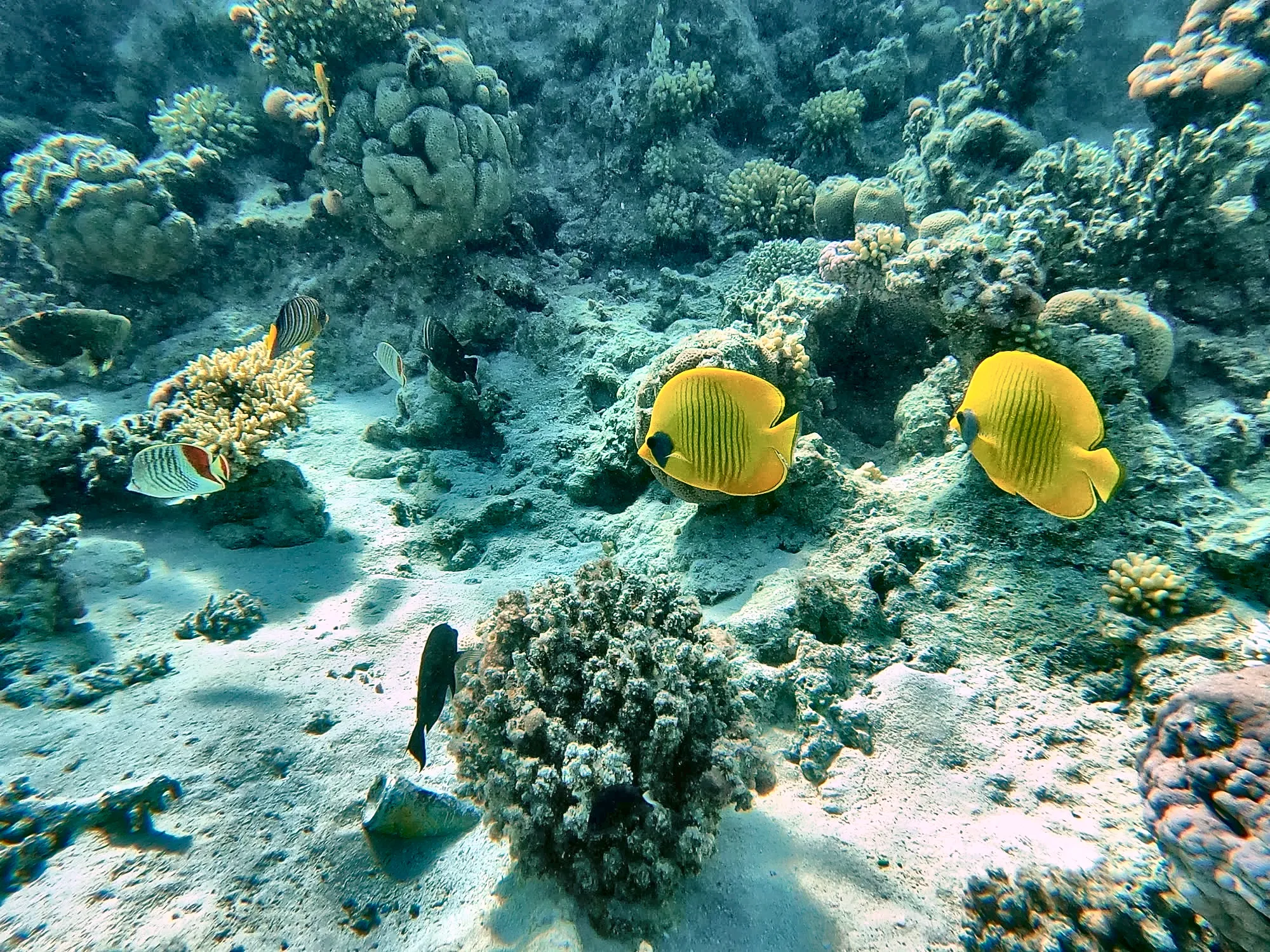
When someone asks me where a beginner should dive into a truly colorful underwater world for the first time, these days I say without hesitation: the Red Sea. What we came across there in one week around Sharm El Sheikh exceeded everything I had expected — at every single reef. The variety of fish and the colors are simply impressive, whether snorkeling right in front of the hotel or on a dive from the boat.
A quick note up front, in case you’re planning right now: The easiest way in is Ras Umm Sid at El Fanar Beach. A jetty leads straight to the reef edge, with no path over sharp corals. It is also the best way in for children. Two of the four reefs you can reach on foot from the beach, two only by boat. Which hotel has its own house reef for this is covered in Snorkeling in Sharm El Sheikh. Neoprene shoes belong in your luggage.
We got to know four reefs more closely: Ras Bob, Ras Umm Sid, Ras Mohammed and Gordon Reef. Here is my honest impression — with everything I would have liked to know beforehand.
All values on this page come from my own week in October 2025, water temperature and visibility from my logbook. What I didn’t see myself is not in here.
The four reefs at a glance
| Reef | Access | Effort | For whom |
|---|---|---|---|
| Ras Bob | from the beach | ~50 m over shallow reef, no jetty | anyone who doesn’t mind the way out — the best reef of the week |
| Ras Umm Sid | from the beach, entry fee | jetty straight to the edge | beginners and anyone who wants it easy |
| Ras Mohammed | boat tour | half a day | anyone who wants to see a reef in the open sea once |
| Gordon Reef | boat tour | half a day | chance of big fish from the boat |
Contents
- The four reefs at a glance
- Ras Bob: the house reef others book a boat tour for
- Ras Umm Sid: the easiest way in — over a jetty straight to the reef edge
- Ras Mohammed: national park with a reef in the middle of the sea
- Gordon Reef: eagle rays from the boat
- Is it dangerous to snorkel in the Red Sea?
- When is the best time to snorkel in the Red Sea?
- My conclusion for beginners
Ras Bob: the house reef others book a boat tour for
| Where | Shark Bay, Sharm El Sheikh — house reef of the Serenity Lodge |
| Getting in | from the beach, no jetty |
| Way to the reef edge | around 50 meters over shallow reef |
| Depth at the reef | 2–5 meters, then it drops off |
| Visibility | around 30 meters (October 2025) |
| Water | 26 °C |
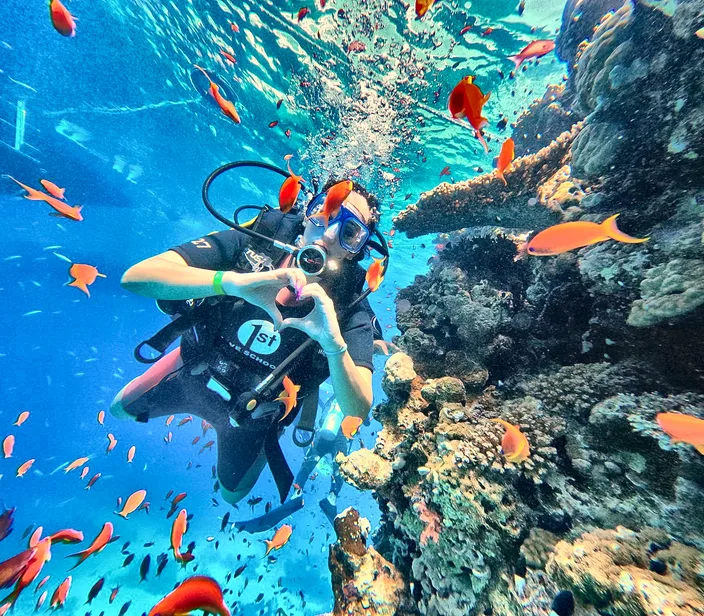
| Seen | eagle rays, blue-spotted rays, white moray (on the move), turtle, needlefish, anthias |
| Best time | early in the morning — then nobody is there |
Our hotel was the Serenity Lodge in Shark Bay — and the real highlight lay right in front of it. Getting in is relatively easy, but I want to be honest: There is no jetty. You first snorkel over a shallow reef, and that isn’t pleasant for everyone. Anyone who can handle it is rewarded after about 50 meters — and properly so.
Because when you then look over the reef edge, it takes your breath away. A wealth of colors, all kinds of fish, and the reef drops away in front of you into the blue. Right there we saw eagle rays, blue-spotted rays — and the only turtle of the whole vacation. Right below the surface hung a needlefish, as if it had been waiting for us.
And a white moray that was moving through the reef. That is something different from the calm moray that later looked out at me from a rock crevice while diving at Ras Mohammed — this one was on the move.
How beautiful this reef really is, we learned in a special way one day. We had booked a snorkeling boat tour and drove forty-five minutes to the boat. Then the boat went back and moored at our own house reef for snorkeling. So there are tours that go all the way to where we simply got into the water in the morning.
Speaking of mornings: We often went snorkeling early, and then you still have the reef all to yourself. Highly recommended.
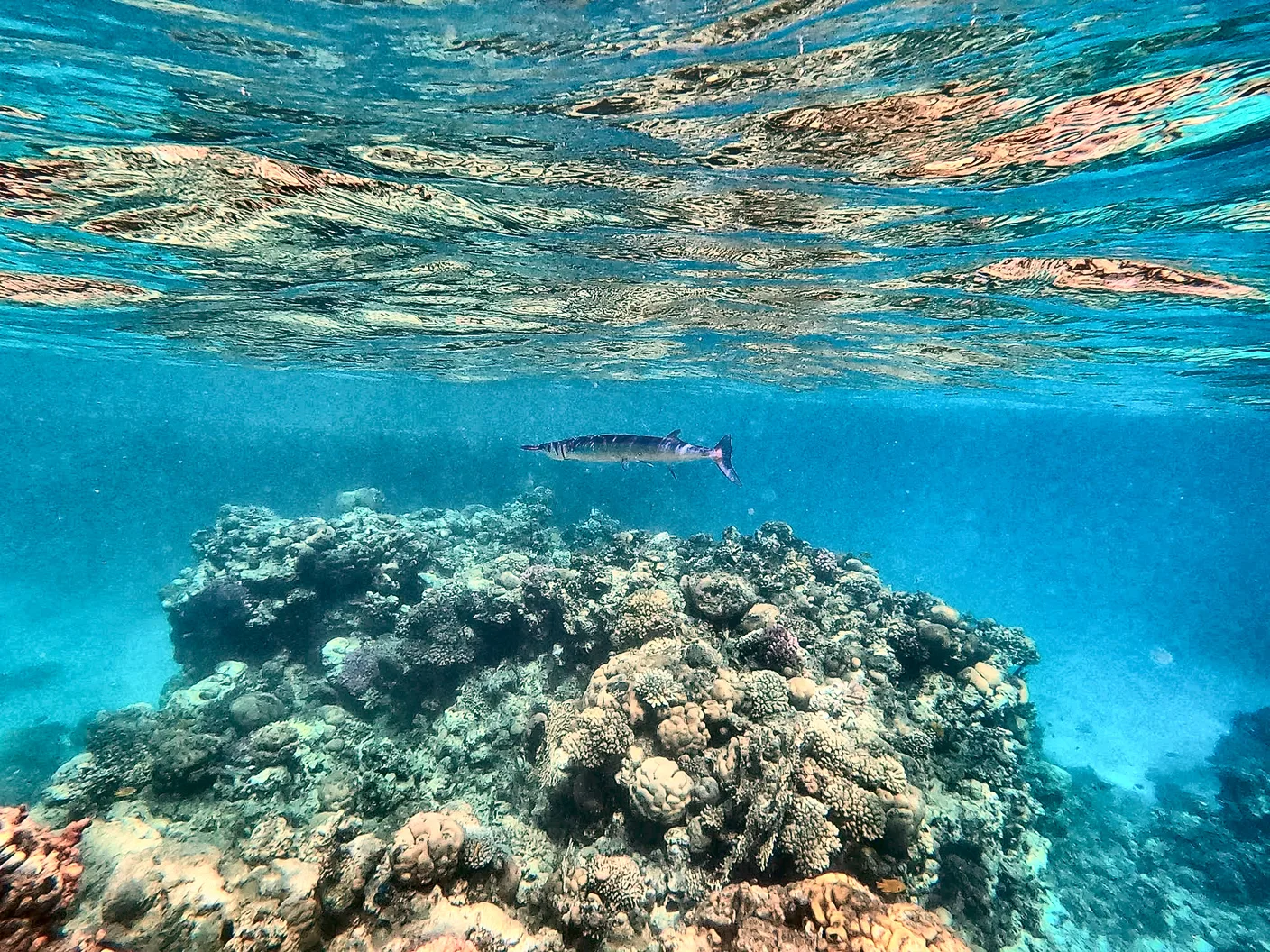
One more thing about the name: The bay is called Shark Bay, but in the whole week I didn’t come across a single shark there — nor in the rest of the vacation. The name describes the bay, not what you see while snorkeling.
One limitation I have to mention: The one turtle was the only one in seven days. Anyone looking specifically for turtles is better off elsewhere — on Rasdhoo in the Maldives we counted about ten in an hour and a half, and on the reef alone. On Mauritius it was exactly one, but reliably — at Turtle Point you are almost sure to find them, but you share them with many other snorkelers. The Red Sea scores with the density on the reef, not with individual big animals.
Ras Umm Sid: the easiest way in — over a jetty straight to the reef edge
| Where | El Fanar Beach, Hadaba district, Sharm El Sheikh |
| Getting in | long jetty straight to the reef edge — no shallow reef |
| Entry fee | around 150 Egyptian pounds (about 3–4 €), lounger and parasol included |
| Reef profile | drops steeply right behind the jetty |
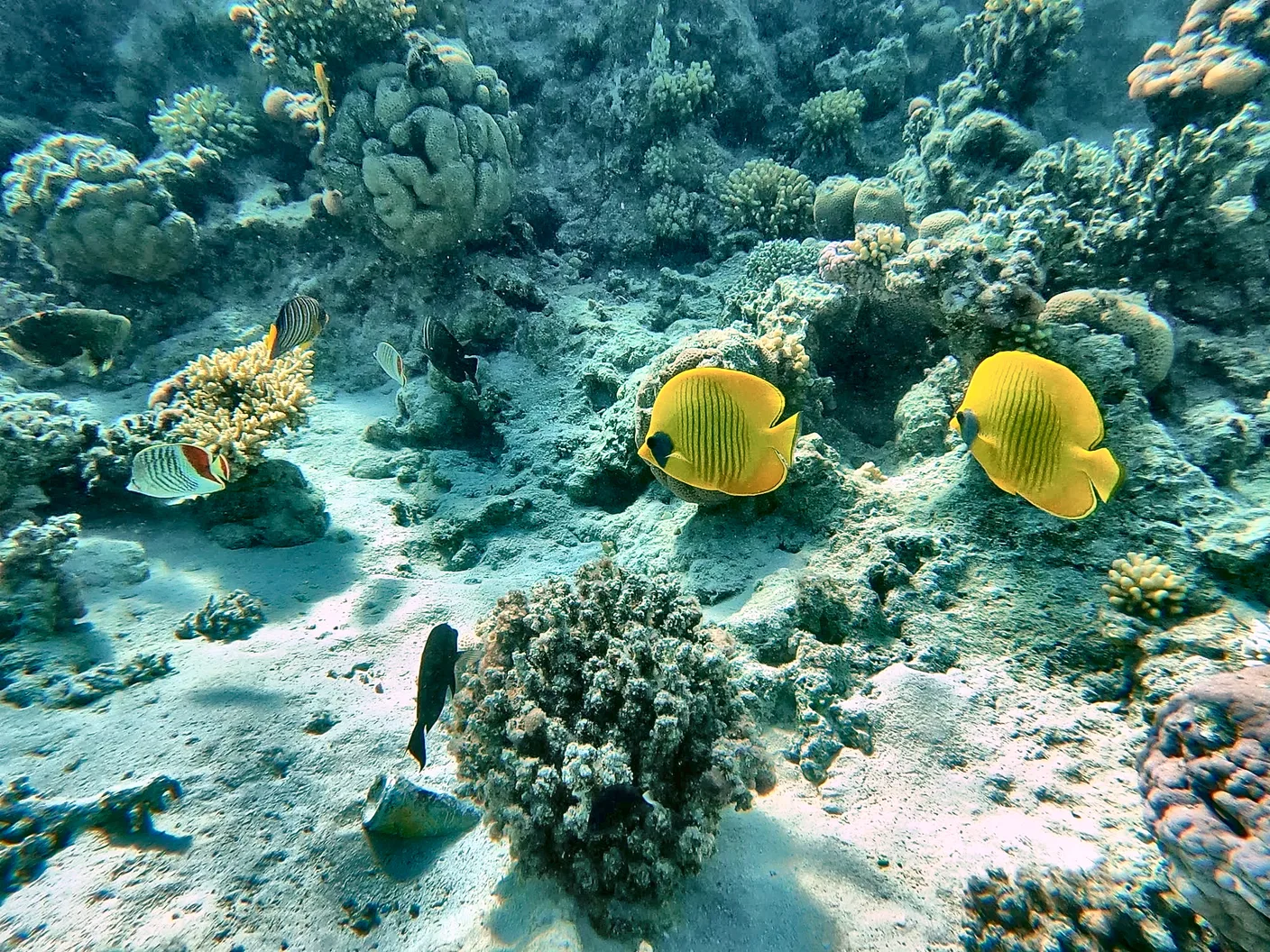
| Seen | masked butterflyfish, reef fish in large numbers |
| On site | small restaurants and bars |
One afternoon we were at El Fanar Beach, a resort where you pay an entry fee — though not much. That’s where the Ras Umm Sid reef is, and getting in couldn’t be easier: A long jetty leads out and ends right at the reef edge. No shallow reef, no climbing — go in and look.
The reef itself drops steeply here. It goes way down, the water has a wonderful blue, and here too: all kinds of fish. Anyone who doesn’t trust themselves with the way in over the shallow reef at Ras Bob is exactly right here.
And the reef beyond is wonderful. Colorful and densely overgrown, with a variety of fish that impressed me. In all colors and shapes, from the palm-sized butterflyfish to the species whose names I don’t even know.
Nowhere did I get more reef for so little money — including a lounger and parasol for the break afterwards.
⭐ For children, this is the best way in on the whole list. From the jetty you go straight into the water. No path over sharp corals, no spot where a child could touch down or cut themselves. It starts right away. That is exactly what makes Ras Bob harder for families: There, fifty meters of shallow reef lie in between first, and that rightly puts people off.
Ras Mohammed: national park with a reef in the middle of the sea
| Where | national park at the southern tip of the Sinai Peninsula |
| Access | only by boat tour from Sharm El Sheikh |
| Getting in | from the boat, reef in the middle of open water |
| Depth | snorkeling over the reef top; when diving, a bright sandy bottom opens up at 18 meters |
| Diving without certification | bookable directly on our boat tour, down to 20 meters |
| Seen | Napoleon wrasse, lionfish in the crevices of the reef |
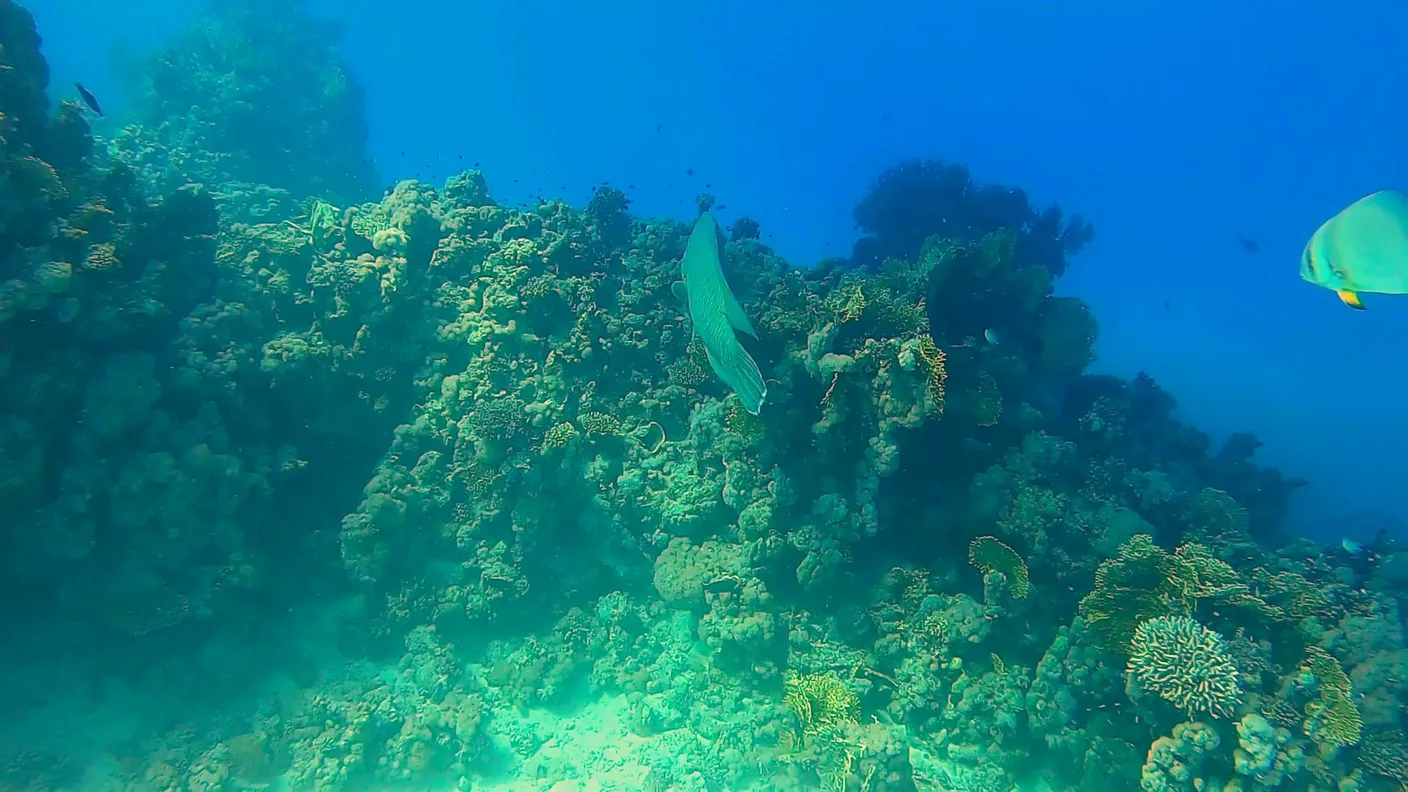
I already knew Ras Mohammed from diving — that’s where I had my first dive in the Red Sea with a Napoleon wrasse and a moray. But the national park is also worth the trip for snorkeling: On our booked boat tour you could snorkel at a reef in the middle of the sea. Nothing but blue all around, below it the reef full of colorful fish — as pretty much everywhere here, but in the middle of open water it feels special all over again.
Diving could be booked directly on the tour, and without certification — which I didn’t have back then. I had still been diving before, so I knew how it feels and what I was getting into. That’s how I got down to 20 meters. How the dive went is in the separate report on it.
Gordon Reef: eagle rays from the boat
| Where | Strait of Tiran, north of Sharm El Sheikh |
| Access | only by boat |
| Getting in | from the boat into open water |
| Seen | eagle rays, dense schools of fusiliers; dolphins on the crossing |
We dived from the boat — at Ras Bob, in Ras Mohammed National Park and at Gordon Reef in the Strait of Tiran. The crossing alone was an experience: On our second boat tour, to Gordon Reef and back to our house reef, dolphins accompanied us. And the reef itself had another surprise in store: eagle rays. Seeing these animals pass by in open water is one of those moments that stay with you.
And here too, what I can say about all the reefs holds true: lots of colorful fish, lots of corals. You get used surprisingly quickly to the fact that underwater it looks like a picture book. That’s exactly why the Red Sea is so well suited for getting started.
Is it dangerous to snorkel in the Red Sea?
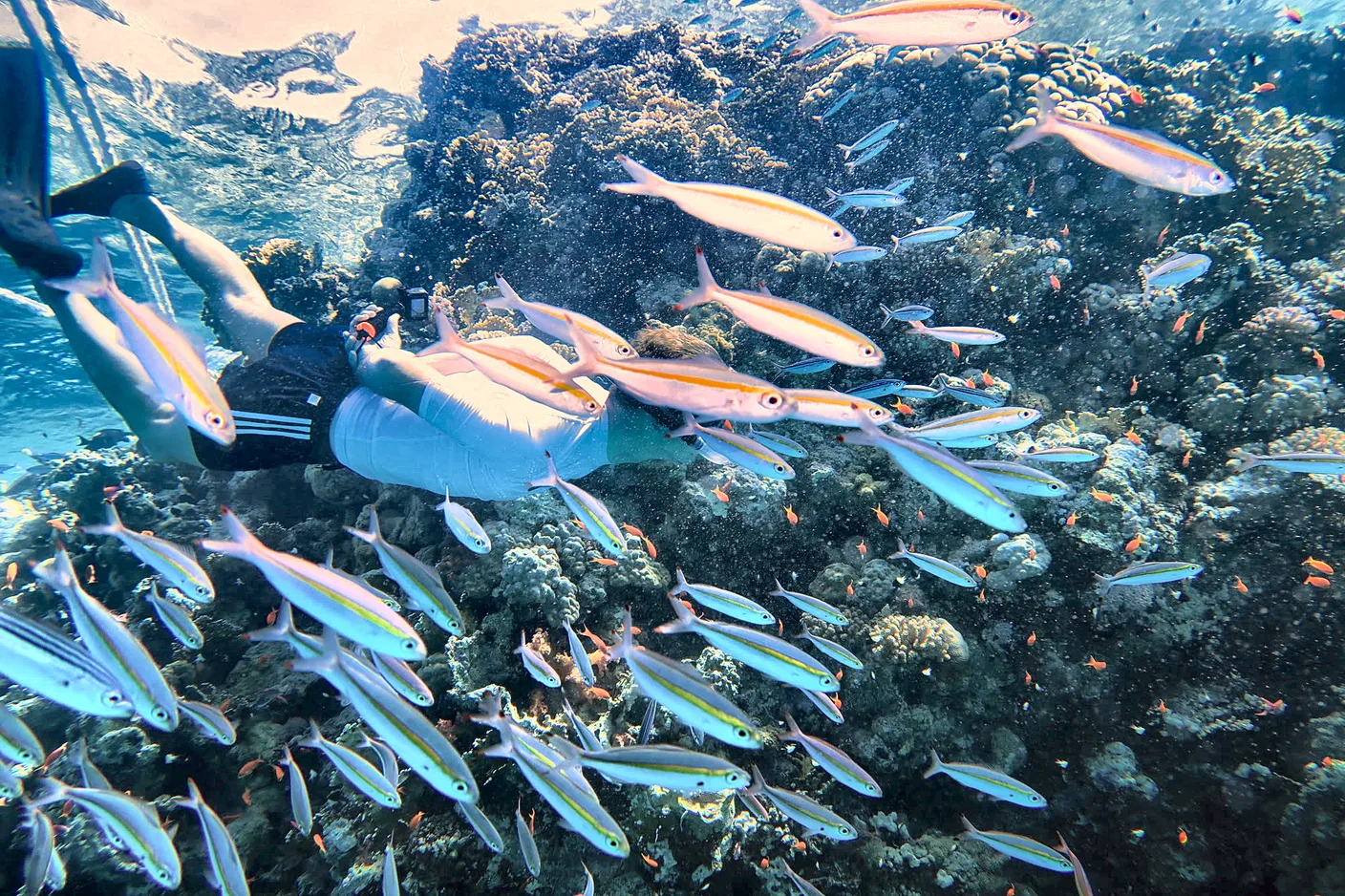
A reef in the Red Sea looks like an overcrowded garden, and that is exactly the trap.
The basic rule is short: touch nothing and keep your distance. It applies to everything down there, without exception — including what looks harmless.
It has two reasons that weigh equally. The reef is damaged when you reach into it or strike it with a fin; much of it grows for decades and is broken in a second. And you yourself get hurt, because much down there defends itself.
Two examples you should know:
Fire corals — mustard-colored, finely branched like twigs. They look like decoration and aren’t: Their stinging cells burn on the skin.
Lionfish hover in the crevices, fins spread like fans. As pretty as that looks, their spines are venomous.
I’d rather keep half a meter more distance than bump into something. You don’t have to touch something that can hurt like that to find it beautiful.
When is the best time to snorkel in the Red Sea?
The Red Sea is the only one of our destinations where you can get into the water all year round. We were there in October: 26 °C water temperature, around 30 meters visibility, milder sun. In winter the water gets cool enough at 21 to 24 °C that you need a wetsuit — but that’s when visibility is best. The complete month-by-month overview with sources is in the Red Sea destination guide.
How it compares with our other destinations: In the Red Sea, visibility was even better, around 30 meters. In the Maldives in April it was around 25 meters at 29 °C. There, the good spots are farther out. We only reached the manta off Rasdhoo and the sharks at Turtle Reef by boat. And at Bikini Beach on Fulidhoo I didn’t find any reef at all. Off Mauritius the water was warm and shallow, but there is no reef there that blows you away.
The difference in one sentence: The reefs in Egypt are wonderful and just as colorful as the Maldivian ones. In the Maldives, only the animals are bigger. The Red Sea scores with the density on the reef, not with individual big animals.
On top of that comes something that weighs more for Europeans than it sounds: The Red Sea is close. You can fly there at short notice without planning a long-haul trip.
For the first time on a tropical reef, that makes it the simplest answer — not because of the number of species, but because so little lies between towel and reef edge.
My conclusion for beginners
- Conditions (October 2025): 26 °C water temperature, around 30 meters visibility, 2 to 5 meters water depth at the reef, down to 20 meters when diving. Values from my logbook.
- The easiest way in: Ras Umm Sid at El Fanar Beach — over the jetty straight to the reef edge, entry fee around 3 to 4 euros. Worth it.
- The best overall package: Ras Bob. The way over the shallow reef takes a bit of willpower, and beyond it waits the most beautiful reef of our vacation — including rays and a turtle.
- The values for each reef: Visibility, water temperature and current are listed with dates on the spot page for Sharm el Sheikh — it also says at which point the current becomes a problem.
- Go early: In the morning you have the reefs almost to yourself.
- Head out once: A boat tour into Ras Mohammed National Park is worth it — a reef in the middle of the sea is an experience of its own.
- Don’t expect: whale sharks, mantas or hammerheads. They are found at the offshore reefs farther out, not at the reefs on this list.
- Gear: For two to five meters, you need little. What I bring along is listed under my gear.
The Red Sea made getting started easy for us — and at the same time gave us moments I won’t forget any time soon. If you know one of these reefs or have a question about getting started: Feel free to write to me, the link is at the very bottom of this page.