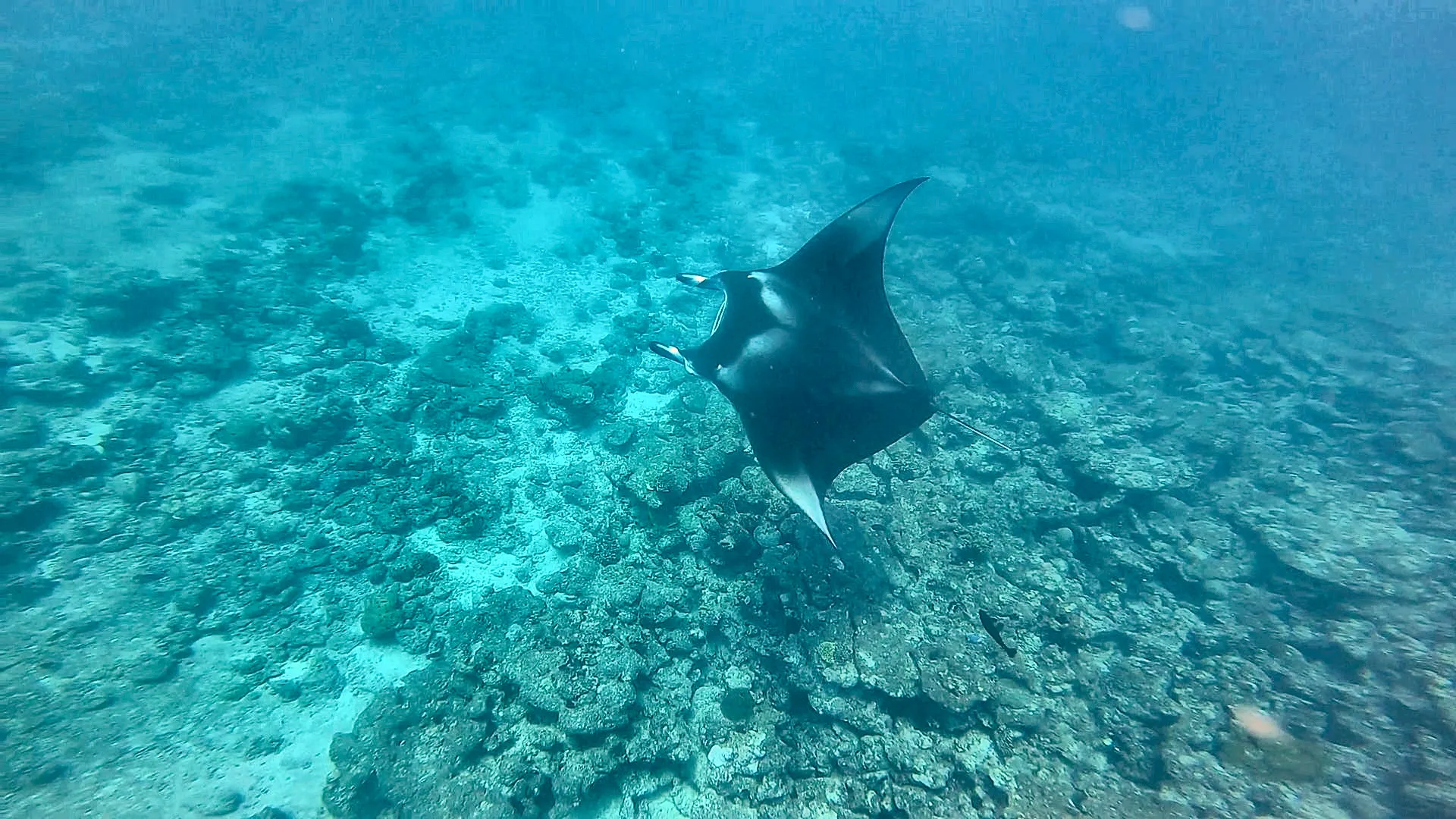
Maalhos, Maldives: snorkeling at the house reef, three thilas and Hanifaru Bay
Translated from the German original.
A quick note first, in case you’re planning right now: From the beach the house reef is minutes away, but where you get in makes more of a difference than when — over the sandy transitions the tide clouds the water, beyond the reef edge it was clear. The special part lies out there: three thilas with over twenty meters of visibility and Hanifaru Bay, twenty minutes away by boat. Below, for each spot, are the date, time, visibility and depth from my logbook.
Maalhos in Baa Atoll is the island from which we did the most excursions — and the reason is simple: excursion prices here were sometimes only half as high as on the other islands.
Tourism has so far largely passed Maalhos by — of the islands on this trip, the most untouched. The old houses here aren’t a museum; people live in them, and away from the Bikini Beach side the island belongs to its residents.
For guests there are two places to stay and two restaurants on the Bikini Beach side, plus a few shops — and that’s about it. The food is good; at Madi Beach Guest House it is also inexpensive.
Not everything here is as clean and polished as elsewhere. But that is exactly part of the charm. You quickly get talking with the locals, and that leads to stories and a real exchange — there is time for that.
Once we were spontaneously invited to a wedding on the island. Lots of good food, right on the beach. That really was something special, and it only happens to you in a place where not everything is set up for guests yet.
We felt well looked after all round, at our accommodation as well as by our snorkeling and diving guide.
Apart from the house reef, every route from here goes by boat — and those were the best tours of the whole trip: three reefs in one morning, a second trip to two more, and Hanifaru Bay, where I was in the water with about fifty mantas. Because the prices were so fair, we went out almost every day. Our son also did his first diving course here and got high praise from the diving instructor.
What excited him most, by the way, was something completely different: that he got to steer the boat, and the diving. Not the turtles, not the mantas, not the colorful fish. That’s worth knowing if you’re planning with a child.
Getting there: By ferry from Kamadhoo, arriving in the morning — RTL runs the short routes between the islands within the atoll. From the harbor, a short walk.
The house reef of Maalhos
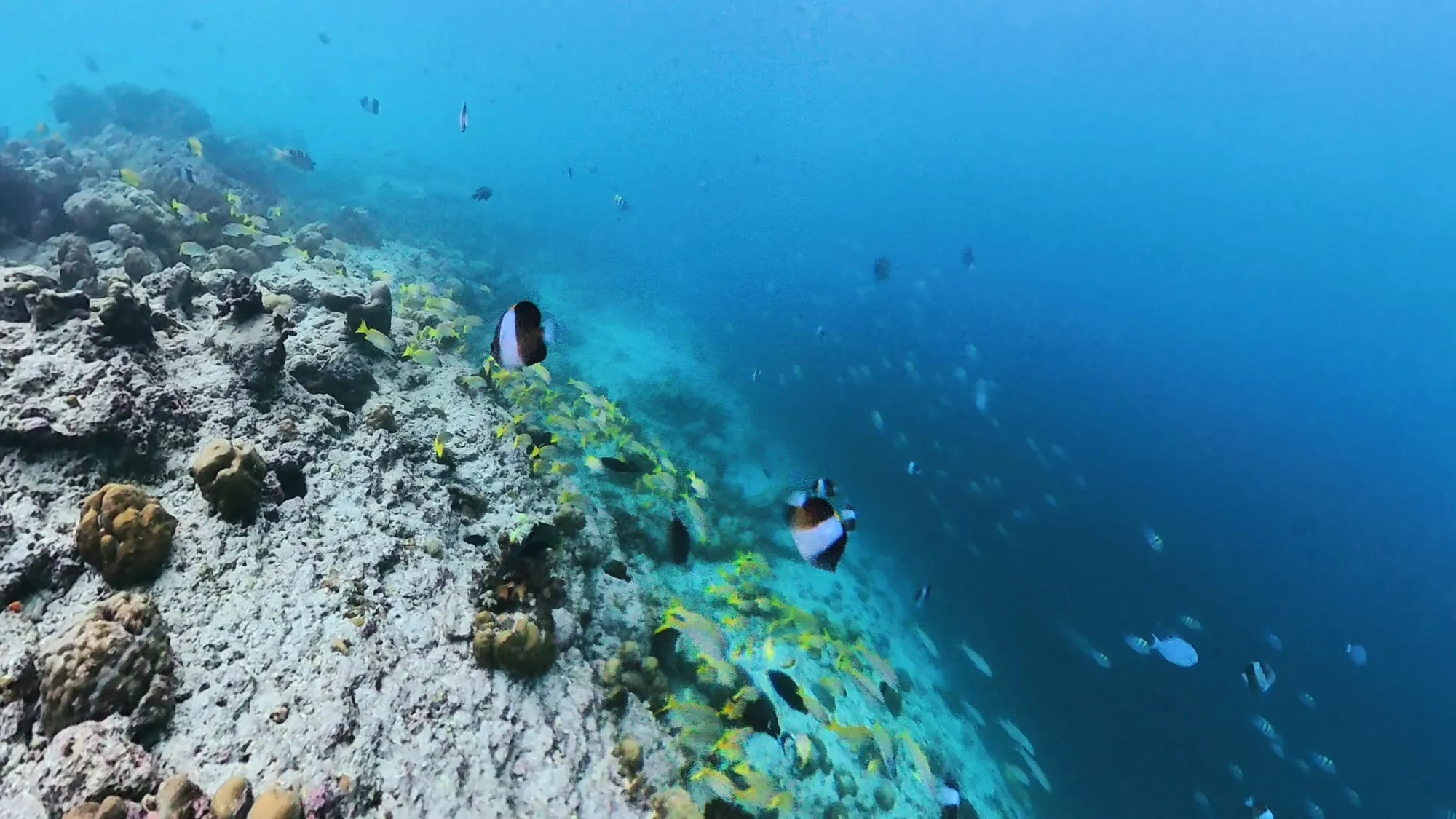
The reef lies very close to the beach and is easy to reach. From the shallows there are many sandy transitions out to the reef — and they are exactly the catch.
On my first afternoon the visibility was moderate: around 15 meters, and the water cloudy with stirred-up sediment. There the reef drops from sandy ground into the depths, and when the tide turns, this very sand gets stirred up. Water 28 °C, air 29.
Three days later I was out beyond the reef edge, where there is no more sand — 15 meters again, but clear this time. Ninety minutes in one go, hard and soft corals, batfish, mullets, starfish and sea cucumbers. On another afternoon we found the lionfish there again that our son had discovered while diving the day before.
So where exactly you get in makes more of a difference here than the day.
To be honest: we didn't see anything truly special at the house reef. There is supposed to be all sorts of things there — none of it came in front of our masks. What the reef offers is the range of ordinary species, not the big show.
House reef, Entry from the beach · Visibility about 15 m to 15 m · Water 28 °C · Current weak · seen myself August 2026
Seen: Lionfish, John Dory, Humphead snapper, Batfish.
Hanifaru Bay
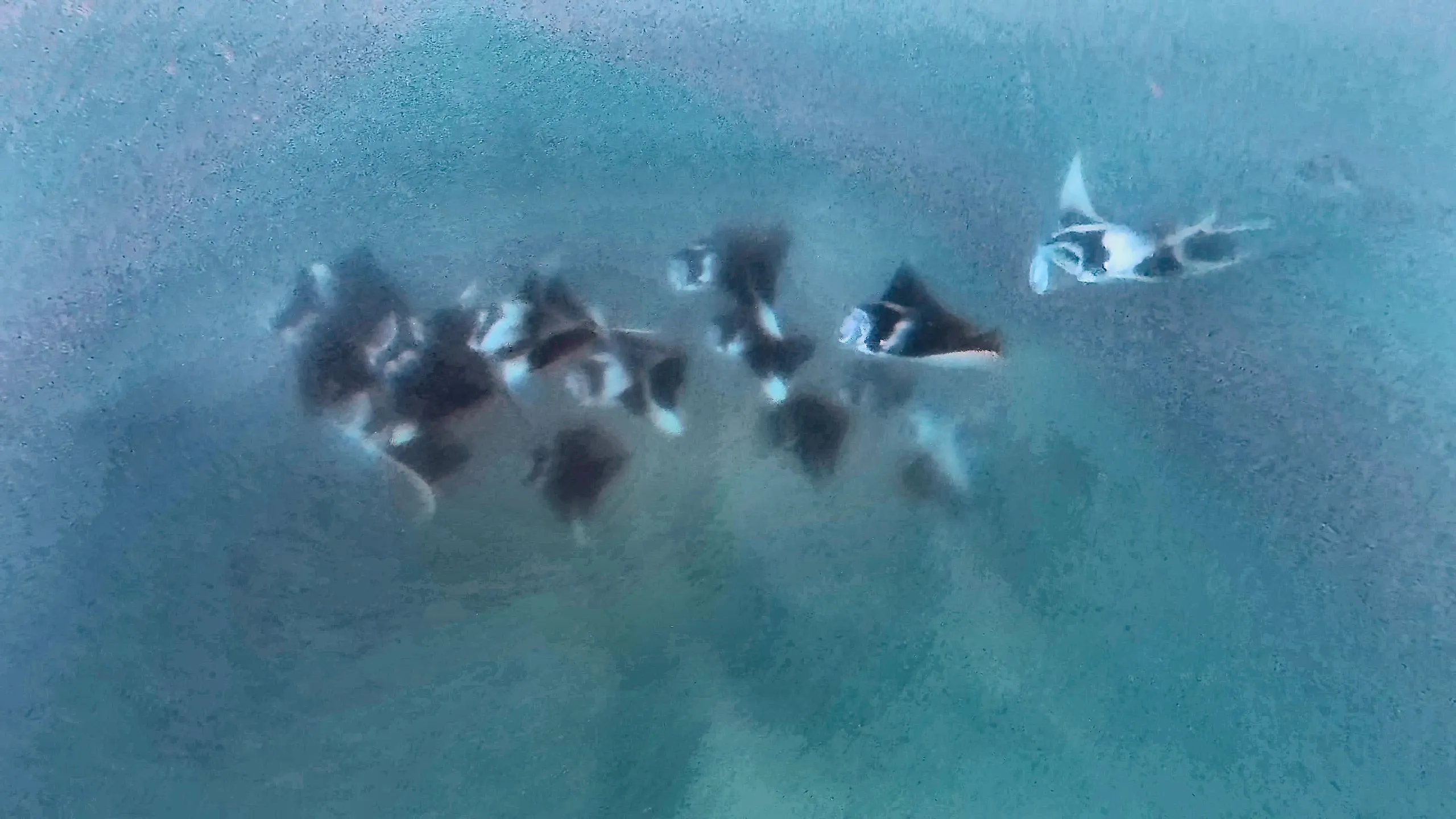
That was the experience of the whole trip. And the astonishing thing about it: at around 10 meters, the visibility was one of the worst I had on this trip.
We set off in the afternoon, the sky overcast, and hardly had we left the harbor when it started to rain. But you're in the Maldives to get wet, after all, and it wasn't cold either.
After about twenty minutes' ride we reach the bay. The boat goes in very slowly so that no animals get hurt — they come up to just below the surface. Everything is monitored by rangers, and I think that's very good: according to the management plan, at most eighty snorkelers may be in the water at the same time, and apparently one day it's the resorts' turn and the next day the local islands'. Because the bay is large, it spreads out — there is none of the chaos like with the whale sharks.
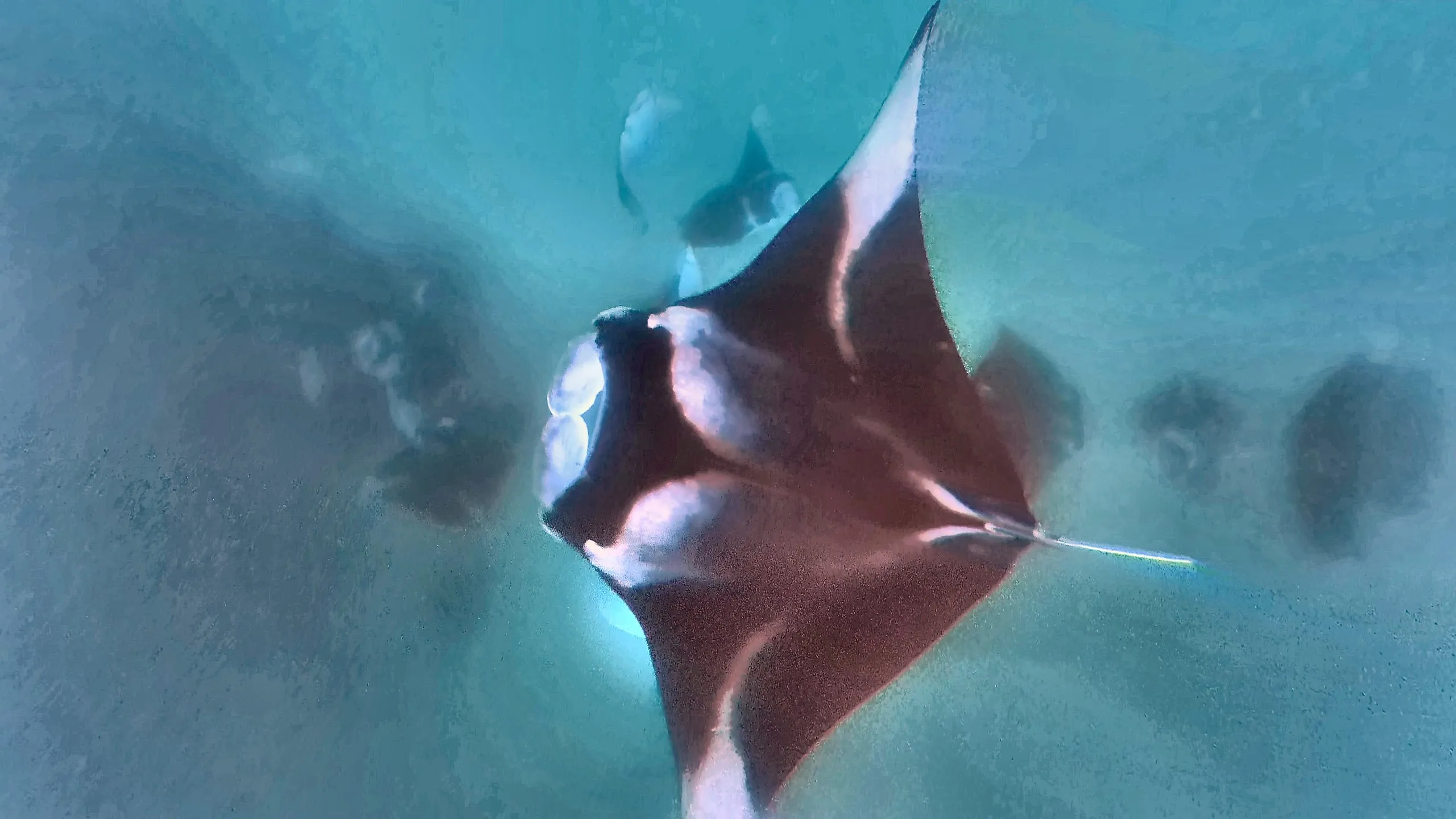
Then into the water. First a little along the surface, and then you see the first mantas — and you're already happy. Then more and more, flying in formation beneath you, loops directly below. You see the light underside, and you don't have the feeling of disturbing the animals. They swim their paths so close that you have to pull in your arms and legs.
After checking with the guide, I dove down, into the middle of the school. These huge animals never touch you. You keep still, you're simply there, and they carefully move aside — never hectic, a small change of course, that's it. Sometimes two swim toward each other and at the last moment both do a loop, with maybe five centimeters of space between them.
Sometimes it seems as if they had made a plan together for how to plow through the sea systematically for food. Almost always in formation, only rarely an animal alone.
We were in the water for thirty to forty minutes, and for maybe two minutes I didn't have a manta in view. There must have been fifty animals in the bay.
Telescopic poles on the camera are forbidden, touching anyway, and you stay with the guide. Why the pole is forbidden, you understand immediately in the water: the animals come so close that you have to move out of the way yourself.
Bay, Entry from the boat · Visibility +10 m · Current light · seen myself August 2026
Seen: Reef manta.
Kihaadhuffaru Thila
The first stop of the two-reef tour and what we called Coral Garden that day. Here the visibility was the best: over 20 meters, no sediment.
A blacktip reef shark passed by, plus tarpons, tuna and needlefish — and the whole colorful reef crowd you expect in the Maldives.
Thila, Entry from the boat · Visibility +20 m · Current moderate · seen myself August 2026
Seen: Blacktip reef shark, Tarpon, Tuna, Needlefish.
UNESCO Thila
This stop was pure chance. On the way from one reef to the other, mantas were spotted at a cleaning station in the middle of the open sea — so we got in, and we actually saw them.
Here you can see that visibility and experience are two different things: over open water it was only a good 10 meters, because there was a lot of plankton in the water. This very plankton is the reason the mantas were there. We were only in for just under a quarter of an hour.
Thila, Entry from the boat · Visibility +10 m · Current light · seen myself August 2026
Seen: Reef manta.
Dhonfanu Reef
The Turtle Reef of the same tour — and the name is right: here we saw two species of turtle at once, the hawksbill and the loggerhead turtle.
Fifty minutes in the water, over 20 meters of visibility, no sediment. The reef has hard corals, plus batfish, needlefish and lots of colorful reef life.
Reef, Entry from the boat · Visibility +20 m · Current moderate · seen myself August 2026
Seen: Hawksbill turtle, Loggerhead turtle, Batfish, Needlefish.
Faana Faru
Faana Faru is what our guide called Coral Garden — and the name fits. It was the first stop of a second two-reef tour; both reefs were very beautiful, and at both the visibility was around 20 meters with no sediment.
Unfortunately I can't tell you the name of the second reef on this tour. We only got screenshots from the guide, and there is no number in the logbook. It was an insider tip.
Reef, Entry from the boat · Visibility about 20 m · Current light · seen myself August 2026
Where I tell more about it
At a glance
- Local feel touristy
localtouristy
- The island above water
- 5/5
- Access to the reef from the beach
- 4/5
- Underwater life at this reef
- 3/5
- Trips in the atoll
- 5/5
Highlights of the island
The most untouched island of the trip — old houses that people live in · Conversations with locals that turn into stories · A spontaneous invitation to a wedding on the beach
Highlights in the atoll
Hanifaru Bay with about fifty mantas · Three reefs in one morning · Turtles at Dhonfanu Reef
My personal assessment, as of August 2026.
What it was like
At the house reef, where you get in makes more of a difference than when: over the sandy transitions the turning tide clouds the water, beyond the reef edge it was clear. Out on the boat trips there was mostly no sediment in the water, and we could see far there. And of all places, in Hanifaru Bay the visibility was among the worst of the whole trip — the plankton that takes it away is exactly the reason the mantas are there.
What the atoll is known for
I did not see this myself — it is here because it belongs to this atoll. Documented, not experienced.
- The whole Baa Atoll is a UNESCO Biosphere Reserve.
- Diving is prohibited in Hanifaru Bay. Snorkeling is limited to 45 minutes at most, under the supervision of rangers and with a limited number of visitors.
- The manta season runs from May to November; the largest aggregations fall between July and October.
- During the season, whale sharks also come into the bay.
- Within the season, the days around full and new moon are the strongest: that is when the tides run most powerfully and push the plankton into the bay. If you can time your trip, put your Hanifaru day in this window.
Sources: Study: environmental factors of manta visits in the Maldives (PMC) · Study: mantas feed on tide-driven plankton patches in Hanifaru Bay (PMC) · Fehivelaa Dive: Hanifaru Bay · No Troubles Just Bubbles: Hanifaru Bay, Baa Atoll · Snorkeling Report: Snorkeling with mantas in Hanifaru Bay