Tips
Spotted eagle ray and blue-spotted ray when snorkeling
- Red Sea and Maldives
- spotted eagle ray and blue-spotted ray
- stinger on the tail
- feeding banned in the Maldives since January 2025
In short In Egypt I saw the blue-spotted ray from the beach, and the spotted eagle ray while snorkeling. Both have a stinger on the tail. In the Maldives, feeding rays has been banned since January 2025.
Translated from the German original.
While snorkeling I estimated visibility, water temperature and depth, just as I experienced them on the days I was there. On dives the dive computer measured depth and duration, and values with a named source show what is usual there, not how it was for me.
When the rays glided over our son’s feet, he was standing in the water at the jetty of Fulidhoo in the Maldives. He was six, excited and not afraid. A shark had not moved, and we still always kept an eye on it. The rays came very close. I leave open which species it was. The whole scene is on the Fulidhoo destination page.
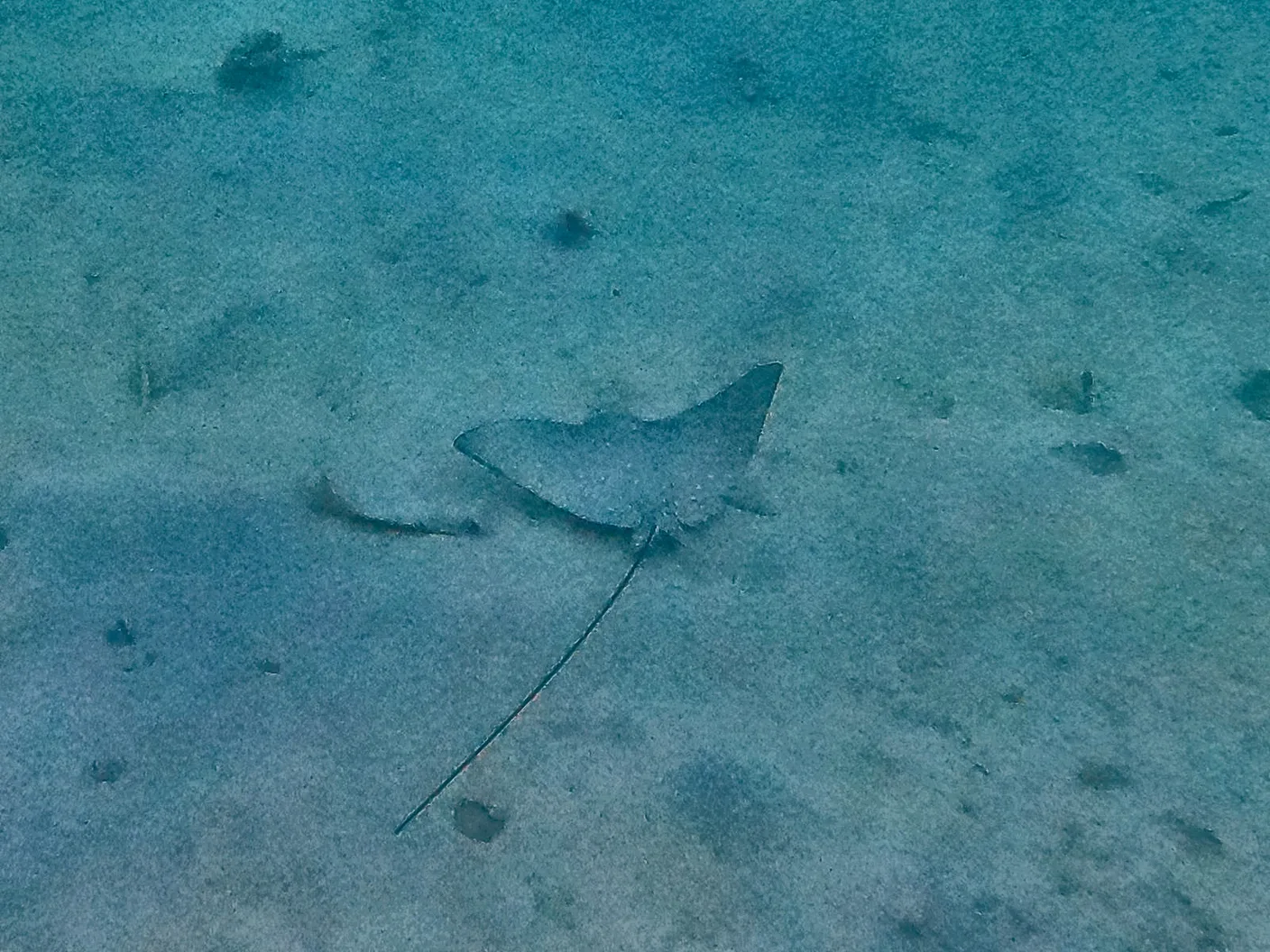
I can identify two species, because I saw them while snorkeling: the spotted eagle ray and the blue-spotted ray. I saw both species in the Red Sea at Ras Bob, the blue-spotted ray even from the beach. I also met the spotted eagle ray on the Maldives island of Kamadhoo.
At a glance
| Spotted eagle ray | Blue-spotted ray | |
|---|---|---|
| How to recognize it | light spots, long thin tail | blue spots, blue stripe on the tail |
| Size | disc up to 3 m, usually 1.8 m | disc up to 35 cm, about 70 cm in total |
| Stinger | on the tail, can injure | usually one on the tail |
| Where seen | Ras Bob and Kamadhoo while snorkeling, Gordon Reef while diving | Ras Bob from the beach and while snorkeling |
| Population | endangered | not threatened |
Sizes, stinger and population according to FishBase and Frontiers in Marine Science, see sources.
Contents
How do I recognize a spotted eagle ray?
By the tail and the spots. The tail is long and thin, and the disc has light spots. You can see this in my video from Egypt, even though the animal is only a small speck in the blue.
Spotted eagle rays get big. FishBase gives a disc width of up to three meters, and about 1.8 meters is usual. They eat clams, snails and crabs from the bottom. They live near the coast, in depths of one to 100 meters according to FishBase, mostly at 20 to 25 meters. According to FishBase, the species occurs in the Red Sea. It says nothing about the Maldives there, but I saw it on Kamadhoo anyway.
The population is shrinking. An analysis in Frontiers in Marine Science (2024) describes a decline of 50 to 79 percent in 39 years. The species is now considered endangered.
How do I recognize a blue-spotted ray?
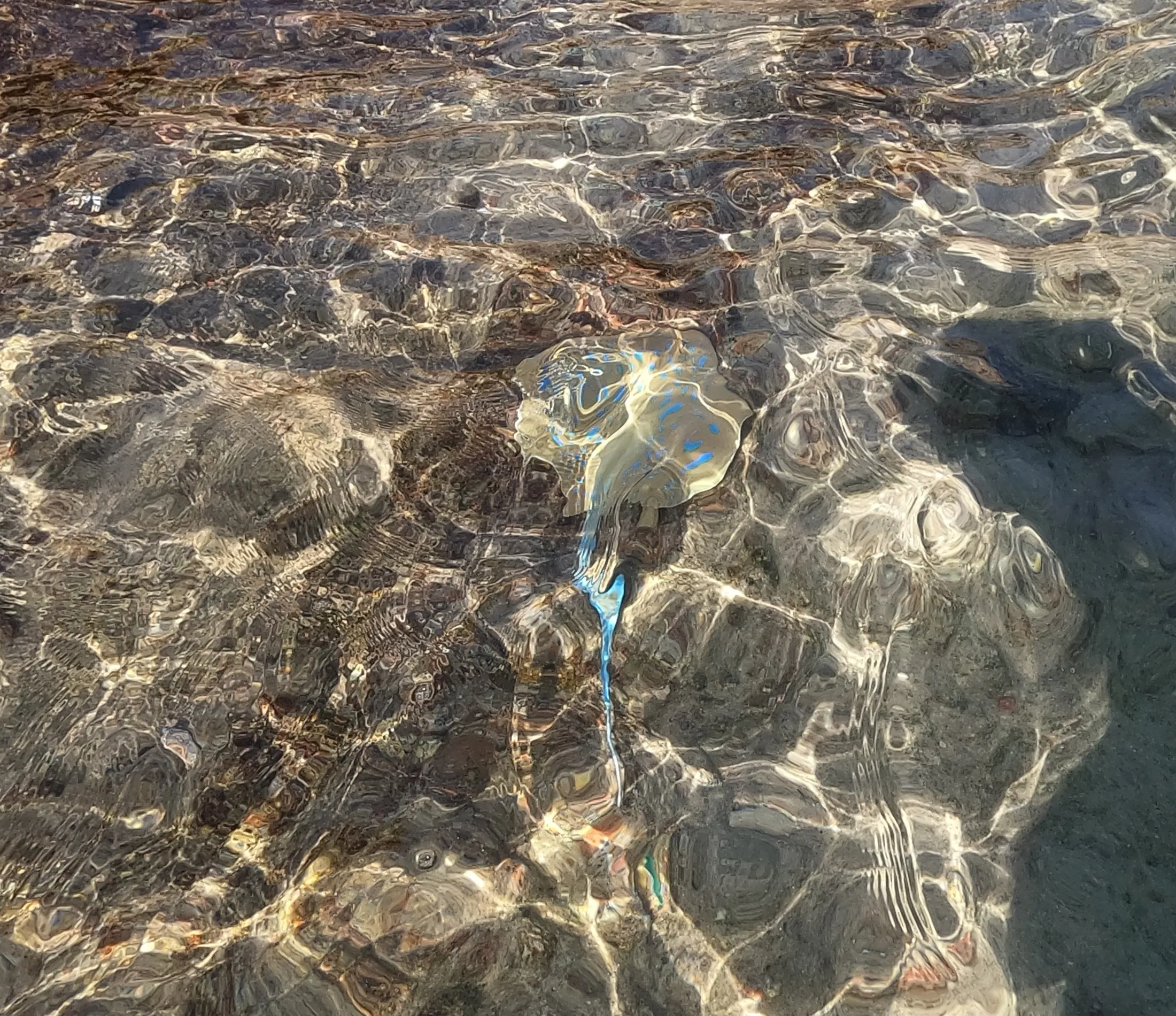
The blue spots give it away. They glow even in shallow water over the pebbles. In the photo from Ras Bob, the blue stripe on the tail comes on top of that.
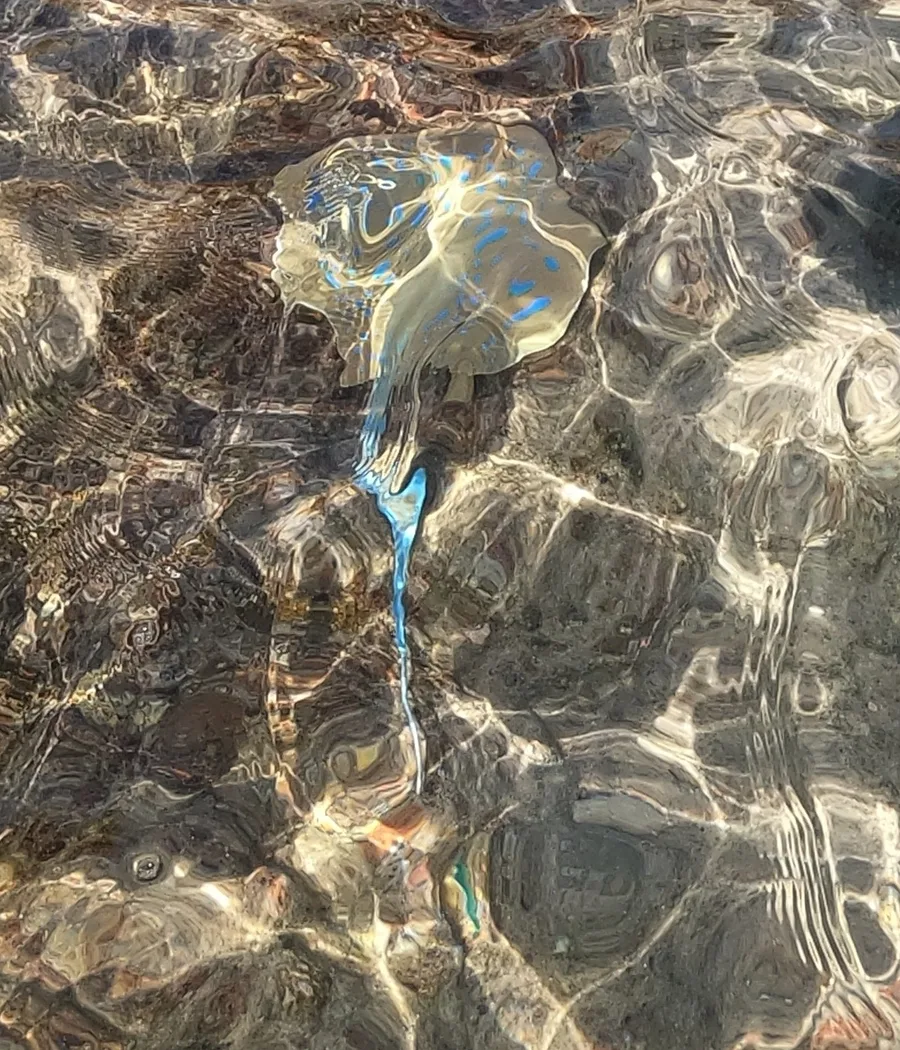
The animal is small. The disc measures 35 centimeters at most, and with the tail it is about 70 according to FishBase. When the tide rises, it moves in groups onto shallow sand flats and eats mollusks there. At low tide it goes into caves and under rock ledges. So shallow sand flats are part of its habitat.
Where did I see the two of them?
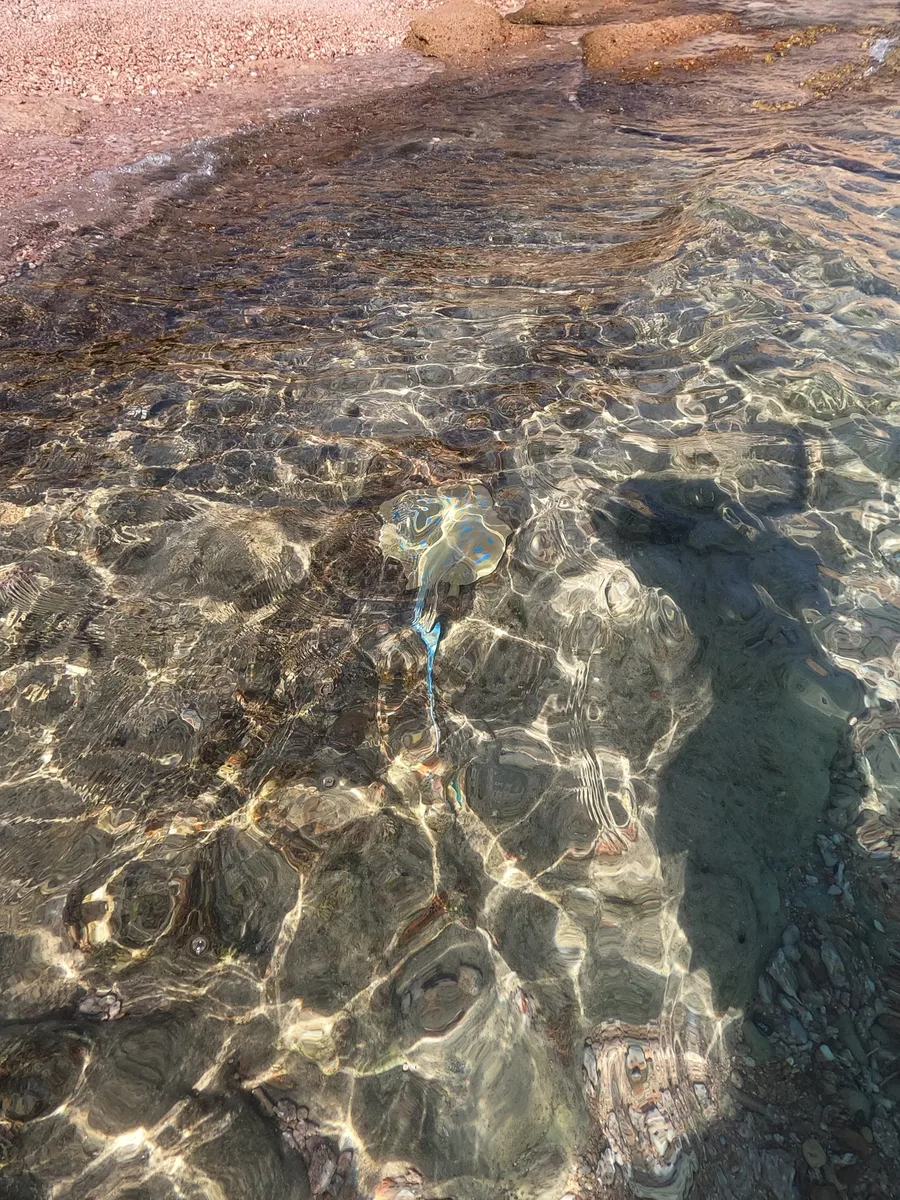
First at Ras Bob. The reef is our house reef in front of the accommodation in Sharm El Sheikh, and the reef edge is about 50 meters from the beach. Out there you first snorkel over a shallow reef. While snorkeling, a spotted eagle ray swam in the water there. The blue-spotted ray lay in the shallow water, seen from the beach, and I took a photo of it on October 28, 2025. I saw it there while snorkeling as well. You can read more about the reef in the Red Sea article.
On Kamadhoo, the reef at Bikini Beach starts after about 30 meters. Near the beach, the bottom is sand with the first corals, the current was light, and the surface was choppy. On August 9, 2026, snorkeling from the beach: turtle, spotted eagle ray, blacktip reef sharks. The Kamadhoo destination page describes the island.
At Gordon Reef I saw the spotted eagle ray only while diving, and I did not snorkel there.
How dangerous is a sting?
Both species carry a stinger on the tail. A sting belongs in a doctor’s hands. According to the medical database WikEM, the wound should go into hot water right away, 45 °C, for 30 to 90 minutes. The venom is sensitive to heat. There is no antivenom, and tetanus protection comes on top of that. The water may be hot but not boiling, advises tauchliebe.de.
If parts of the stinger stay in the wound, you should not remove them yourself, writes tauchliebe.de. The site says to call the emergency number for pain that does not ease, for a sting in the chest or abdomen, and for breathing or circulation problems. WikEM lists cramps, vomiting and a drop in blood pressure, among others, as warning signs.
For the spotted eagle ray, tauchliebe.de sees only a very low danger. For stingrays in shallow water, the site advises shuffling your feet flat over the bottom instead of taking steps. According to it, most stings happen when someone accidentally steps on an animal.
Whether a blue-spotted ray buries itself, the sources say differently. FishBase writes that it does so rarely. malediven.biz describes stingrays in shallow water as burying themselves in the sand.
Are you allowed to feed rays?
In the Maldives, it has been banned since January 2025. The environmental agency EPA ordered on January 16, 2025 that all feeding of rays be stopped. The ban applies to all ray species. The basis of the order is the Protected Species Regulation, which prohibits harmful activities, including feeding. According to the agency, rays and young sharks get used to people with food, sharks are attracted to feeding spots, and injuries to snorkelers and divers have been recorded there. The report does not say how high the penalty is.
For a visit, what applies everywhere on the reef applies: keep your distance and touch nothing.
My conclusion
Manta rays are rays too, only without a venomous stinger. More about the mantas in the Maldives is in My first manta on Rasdhoo. For the other rays, three things are enough. In shallow water, shuffle your feet over the bottom. After a sting, hot water and a doctor. Don’t feed rays.
Frequently asked questions
Are spotted eagle rays poisonous? They have a stinger on the tail, and FishBase notes that it can cause injuries. I found no information on the venom itself for this species. tauchliebe.de sees only a very low danger.
How big does a blue-spotted ray get? The disc measures up to 35 centimeters, and with the tail it is about 70.
How many stingers does a blue-spotted ray have? According to FishBase, usually one.
What should I do after a sting? See a doctor. Until then, hot water at 45 °C helps, write WikEM and tauchliebe.de.
Are there spotted eagle rays in the Maldives? At Bikini Beach on Kamadhoo, the spotted eagle ray was there while snorkeling. I did not find a species list for the Maldives.
Sources
- FishBase: spotted eagle ray, Aetobatus ocellatus, retrieved on October 20, 2026
- FishBase: blue-spotted ray, Taeniura lymma, retrieved on October 20, 2026
- Frontiers in Marine Science (2024), analysis on the spotted eagle ray, retrieved on October 20, 2026
- WikEM: Stingray injury, retrieved on October 20, 2026
- tauchliebe.de: Are rays dangerous, retrieved on October 20, 2026
- malediven.biz, article on stingrays and mantas: Are manta rays dangerous, retrieved on October 18, 2026
- Environmental agency EPA Maldives, order of January 16, 2025: edition.mv, January 17, 2025, mfr.mv, January 18, 2025
Read more
- Snorkeling the Red Sea: four reefs for beginners: Ras Bob, my house reef in Egypt
- Snorkeling in Sharm El Sheikh: from the beach to the reef edge
- My first manta on Rasdhoo: manta rays are rays too, but without a venomous stinger
- Maldives with kids: what we experienced in the water with our son